AC Vent Dripping Water From the Ceiling: What to Do First
Water dripping from a ceiling AC vent? Protect your stuff, learn why condensation forms, check the filter, and report it fast so a small drip doesn't grow.
“Almost cried fixing my own house. Learned to read every quote instead.”
Theology · Scripture Cards
Open a scripture card
Already read and shared by 315 people.
 Your Faith Has Made You Well
Mark 10:52
Jesus said to him, “Go your way. Your faith has made you well.” Immediately he received his sight and followed Jesus on the way.
Read this card
 I Am with You Always
Matthew 28:20
teaching them to observe all things that I commanded you. Behold, I am with you always, even to the end of the age.” Amen.
Read this card
 Until He Finds It
Luke 15:4, 6
“Which of you men, if you had one hundred sheep and lost one of them, wouldn’t leave the ninety-nine in the wilderness and go after the one…
Read this card
 Water from the Rock
Exodus 17:6
Behold, I will stand before you there on the rock in Horeb. You shall strike the rock, and water will come out of it, that the people may…
Read this card
 I Am with You
Genesis 28:15
Behold, I am with you, and will keep you, wherever you go, and will bring you again into this land. For I will not leave you until I have…
Read this card
 I Am the Resurrection and the Life
John 11:25-26
Jesus said to her, “I am the resurrection and the life. He who believes in me will still live, even if he dies. Whoever lives and believes…
Read this card
 Surely I Will Be with You
Judges 6:16
Yahweh said to him, “Surely I will be with you, and you shall strike the Midianites as one man.”
Read this card
 Bread from Heaven
Exodus 16:4
Then Yahweh said to Moses, “Behold, I will rain bread from the sky for you, and the people shall go out and gather a day’s portion every…
Read this card
Key Takeaways
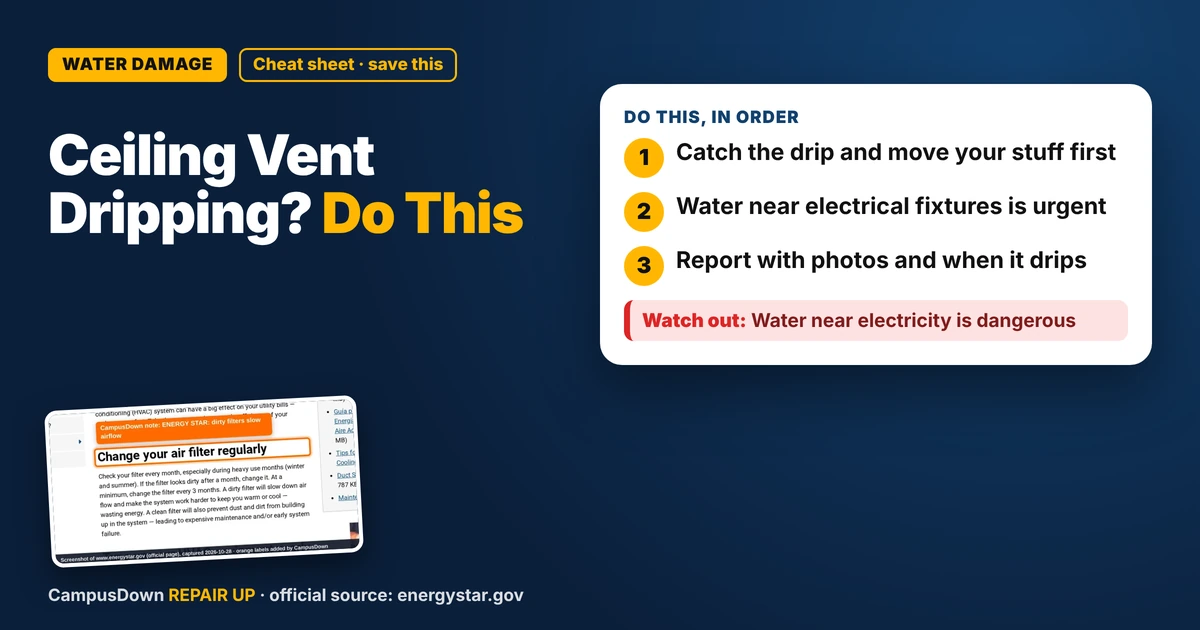
- Catch the drip and move your stuff first
- Water near electrical fixtures is urgent
- Report with photos and when it drips
I was eating cereal when a drop of water landed on my head. I looked up and saw the ceiling vent crying. Not dramatically, just steady drips, like it had seen my love life. If your AC vent is dripping water from the ceiling, here's what I did.
First steps
- Put a bucket or towel under the drip.
- Move electronics, books and anything you care about.
- Check if water is near light fixtures or outlets. If it is, avoid them and tell your landlord right away.
- Take photos and a short video.
Why vents drip
AC pulls heat from air. When warm, humid air hits cold surfaces, water condenses. That's heat transfer doing its thing. The laws of thermodynamics say heat moves from hot to cold, and moisture comes along for the ride when the air cools.
Common reasons vents drip:
- Condensation on the vent or duct.* Humid air meeting a cold vent can sweat.
- Clogged condensate line.* Water from the AC normally drains away; if the line clogs, it can back up.
- Dirty filter or frozen coil.* Restricted airflow can lead to ice that melts and drips.
- Duct problems.* Poorly sealed or uninsulated ducts can sweat.
What you can check
The ENERGY STAR heating and cooling page says to check your filter every month and change it at least every 3 months, since a dirty filter slows airflow. If changing the filter is your job, check it. Other parts, like the condensate line or air handler, usually belong to the landlord.
ENERGY STAR also says improper installation can reduce efficiency by up to 30 percent, and duct sealing can improve efficiency up to 20 percent. Those are pro jobs, but they explain why a drip might come back if the root cause isn't fixed.
Report it fast
Water damage gets worse with time. Ceiling stains, swelling drywall and mold are all on the menu if it keeps dripping. Over time, everything slides toward disorder, the household version of the law of entropy. Tell your landlord the same day with photos, location and when it started.
Things not to do
- Don't poke the ceiling.
- Don't open the air handler or AC unit.
- Don't ignore a stain because "it stopped."
After the drip stops
Even after a fix, keep an eye on the ceiling for a few weeks. A stain that grows, a soft spot or a musty smell can mean water got into the drywall. Mention those in writing too.
Hypothetical
Hypothetical: the drip stops when you turn off the AC and starts again when you turn it on. That points toward AC condensation or drainage, which is useful to tell the repair person.
Found this helpful? Share it with a friend who’s dealing with the same mess.
Pick an app — it just sends the link, nothing else.
Frequently Asked Questions
Why is my AC vent dripping water?
Condensation, a clogged drain line, a dirty filter or duct problems are common causes.
Is a dripping AC vent an emergency?
If water is near electrical fixtures, treat it as urgent.
Can I fix a dripping AC vent myself?
You can catch water and check the filter. Drain lines and ducts are landlord jobs.
Should I turn off the AC?
Turning it off can slow the drip until it's checked.