My Ceiling Is Sagging Like a Hammock. Now What?
Ceiling drywall bulging or sagging after a leak? Why it's a move-away moment, where EPA says hidden mold hides, and how to report it to your landlord.
“Almost cried fixing my own house. Learned to read every quote instead.”
Theology · Scripture Cards
Open a scripture card
Already read and shared by 315 people.
 Surely I Will Be with You
Judges 6:16
Yahweh said to him, “Surely I will be with you, and you shall strike the Midianites as one man.”
Read this card
 God Shut the Lions’ Mouths
Daniel 6:22
My God has sent his angel, and has shut the lions’ mouths, and they have not hurt me, because innocence was found in me before him; and…
Read this card
 The Rainbow Covenant
Genesis 9:13, 16
I set my rainbow in the cloud, and it will be a sign of a covenant between me and the earth. … The rainbow will be in the cloud. I will…
Read this card
 I Am the Light of the World
John 8:12
Again, therefore, Jesus spoke to them, saying, “I am the light of the world. He who follows me will not walk in the darkness, but will have…
Read this card
 A Fourth Walking in the Fire
Daniel 3:25
He answered, “Look, I see four men loose, walking in the middle of the fire, and they are unharmed. The appearance of the fourth is like a…
Read this card
 He Revealed His Glory
John 2:11
This beginning of his signs Jesus did in Cana of Galilee, and revealed his glory; and his disciples believed in him.
Read this card
 His Flesh Was Restored
2 Kings 5:14
Then he went down and dipped himself seven times in the Jordan, according to the saying of the man of God; and his flesh was restored like…
Read this card
 Salvation Is of the Lord
Jonah 2:6, 9
I went down to the bottoms of the mountains. The earth barred me in forever; yet you have brought my life up from the pit, Yahweh my God. ……
Read this card
Key Takeaways
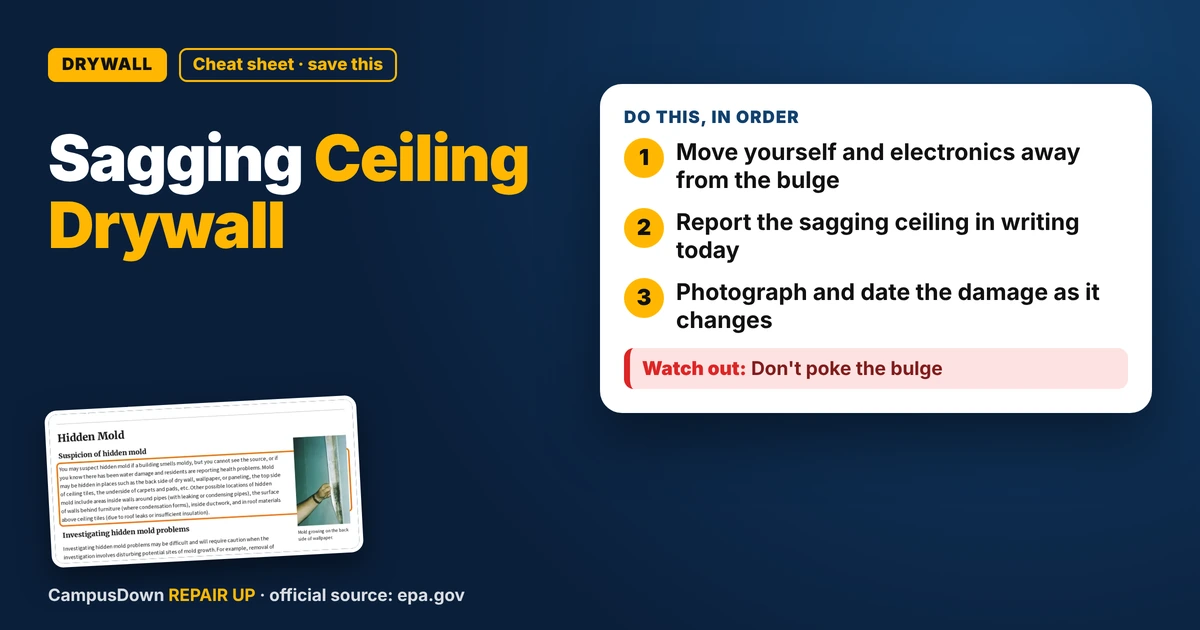
- Move yourself and electronics away from the bulge
- Report the sagging ceiling in writing today
- Photograph and date the damage as it changes
I was lying in bed scrolling when I noticed the ceiling above my desk had a soft, droopy belly, like a hammock nobody asked for. There was a faint stain around it too. If your ceiling drywall is sagging after a leak, I'll be straight: this is not a fix-it-yourself moment for a renter. It's a move-your-stuff-and-report-it moment.
First: get out from under it
I can't find an official source I trust that tells you exactly when a wet ceiling gives way, so I won't guess. What I can say is common sense: a bulging, wet ceiling is heavy and holding water you can't see. Move electronics, your bed, and yourself away from it, put a bucket nearby if it's dripping, and don't poke it.
Why the leak matters more than the drywall
The EPA's brief guide to mold, moisture, and your home says it's important to dry water-damaged areas and items within 24 to 48 hours to prevent mold growth. A sagging ceiling usually means water has been sitting there a while.
The guide also lists where mold can hide: the back side of drywall, wallpaper, or paneling, and the top side of ceiling tiles, plus roof materials above ceiling tiles due to roof leaks. So the part you can see may be the small part.
EPA adds that absorbent or porous materials, like ceiling tiles and carpet, may have to be thrown away if they become moldy, because mold can fill the crevices of porous materials and be difficult or impossible to remove completely. That's the landlord's call, not mine.
Reporting it
Here's my hypothetical message, short and in writing:
"The ceiling above my desk is bulging and stained, likely from a leak above. I've moved my things away. Can maintenance come today or tomorrow? Photos attached."
Rules about repair timelines vary by state and lease, so I won't claim a deadline. Writing it down gives you a dated record.
What a repair usually involves
For context only, iFixit's water-damaged ceiling guide shows cleaning the area, trimming in a drywall patch, sanding, spackling, and using a stain-blocking or mold-resistant primer before repainting. That's after the leak is fixed and everything is dry.
Why we wait too long
The planning fallacy says I'll deal with it after midterms. Procrastination agrees. And people with asthma or allergic rhinitis may have extra reason to want moisture problems handled early; ask a doctor about your own situation.
If this saved you a headache, it might save a friend one too.
Pick an app — it just sends the link, nothing else.
Frequently Asked Questions
Is a sagging ceiling dangerous?
It may be holding water, so keep people and electronics away and report it right away.
Can mold hide above a ceiling?
EPA lists the top side of ceiling tiles and roof materials above them as places hidden mold can grow.
How fast should a leak be dried?
EPA says dry water-damaged areas within 24 to 48 hours to prevent mold growth.
Should I fix a sagging ceiling myself?
As a renter, report it in writing and let the landlord handle the leak and repair.