My Fan Was Spinning the Wrong Way All Winter (Probably)
Ceiling fan direction in winter matters in a drafty apartment. How to find the switch, what clockwise does, and safe steps before you touch the fan at all.
“Almost cried fixing my own house. Learned to read every quote instead.”
Theology · Scripture Cards
Open a scripture card
Already read and shared by 315 people.
 The Lord Will Provide
Genesis 22:14
Abraham called the name of that place “Yahweh Will Provide”. As it is said to this day, “On Yahweh’s mountain, it will be provided.”
Read this card
 For Such a Time as This
Esther 4:14
For if you remain silent now, then relief and deliverance will come to the Jews from another place, but you and your father’s house will…
Read this card
 This Is My Beloved Son
Matthew 3:16-17
Jesus, when he was baptized, went up directly from the water: and behold, the heavens were opened to him. He saw the Spirit of God…
Read this card
 Not My Will, but Yours
Luke 22:42
saying, “Father, if you are willing, remove this cup from me. Nevertheless, not my will, but yours, be done.”
Read this card
 Daughter, Your Faith Has Healed You
Mark 5:34
He said to her, “Daughter, your faith has made you well. Go in peace, and be cured of your disease.”
Read this card
 I Am the Resurrection and the Life
John 11:25-26
Jesus said to her, “I am the resurrection and the life. He who believes in me will still live, even if he dies. Whoever lives and believes…
Read this card
 Bread from Heaven
Exodus 16:4
Then Yahweh said to Moses, “Behold, I will rain bread from the sky for you, and the people shall go out and gather a day’s portion every…
Read this card
 Water from the Rock
Exodus 17:6
Behold, I will stand before you there on the rock in Horeb. You shall strike the rock, and water will come out of it, that the people may…
Read this card
Key Takeaways
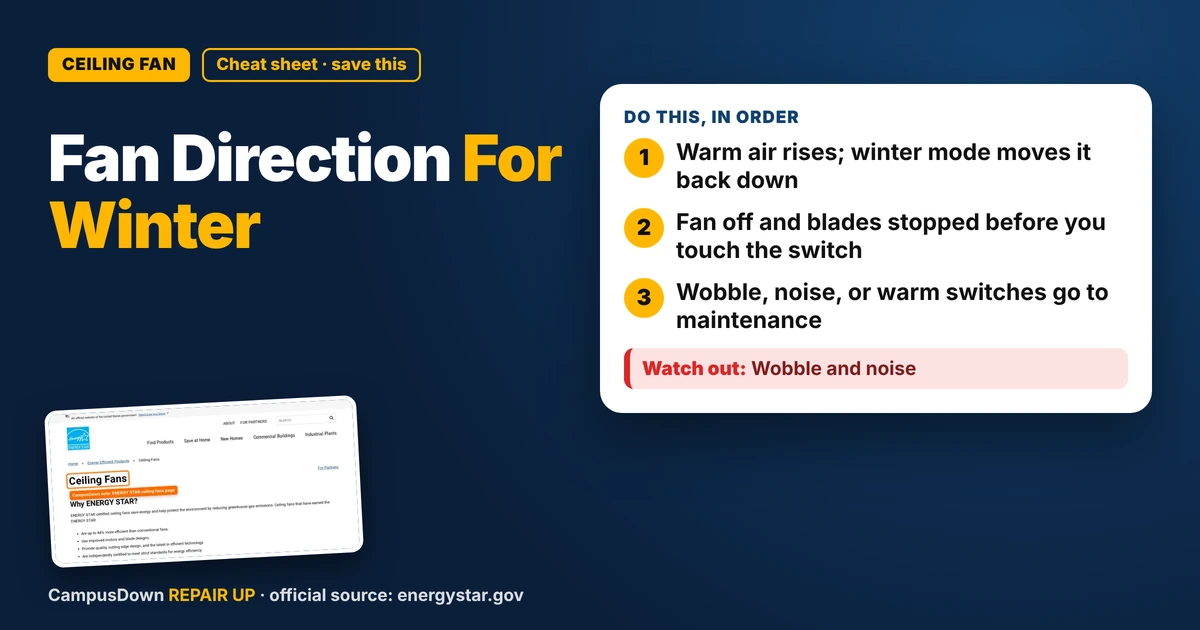
- Warm air rises; winter mode moves it back down.
- Fan off and blades stopped before you touch the switch.
- Wobble, noise, or warm switches go to maintenance.
Every winter my apartment turns into a walk-in freezer and my heating bill turns into a horror movie. Then a friend asked which way my ceiling fan was spinning, and I realized I had no idea. If you're searching ceiling fan direction in winter, you're in the same boat, so let's figure it out without breaking anything or anyone.
Why direction matters at all
Warm air rises. That's basic heat transfer, specifically convection doing its thing. In a room with a high ceiling, the warm air hangs out up top where you aren't. A fan spinning one way pushes air straight down at you, which feels like a breeze. Spun the other way at low speed, it pulls air up and pushes the warm layer gently down the walls, so you don't get a cold draft in your face.
General rule of thumb you'll see a lot: counterclockwise (looking up) in summer for a cooling breeze, clockwise on low in winter to move warm air without the wind chill. Fans differ, so check your model's manual or label if you can find it.
Step 1: Find the switch safely
- Turn the fan off and wait until the blades fully stop. Do not grab spinning blades. Ever.
- Look on the motor housing (the part above the blades) for a small slide switch.
- Use a sturdy step stool, not a rolling desk chair. My chair has betrayed me before.
- Some fans have no switch and change direction from a remote or wall control.
Step 2: Flip it and test
Flip the switch, turn the fan on low, and stand under it. In winter mode you should barely feel air on your face. If it feels like a wind tunnel, you're on the summer setting or the speed is too high.
What ENERGY STAR says about fans
The ENERGY STAR ceiling fans page covers certified fans and fan-light combos that are designed to move air more efficiently. If your landlord is replacing a dead fan anyway, it's a fair thing to mention. I'm not buying a fan for a rental, but I can at least bring up the label.
Don't expect miracles
A fan won't fix single-pane windows or a broken heater. It just helps the heat you already paid for reach you. Expecting one switch to solve everything is optimism bias talking. Also, the Jevons paradox idea is a fun warning: if the room feels better and I crank the thermostat anyway, I just undid the point.
When to call maintenance
- The fan wobbles, grinds, or the canopy is pulling away from the ceiling.
- The light flickers or the wall switch feels warm.
- There's no direction switch and no remote, and you want it set up right.
- The heat in the unit doesn't keep the place reasonably warm at all.
A cheap winter combo
Pair the fan trick with closing blinds at night, a draft stopper at the door, and a rug if you have bare floors. None of it is fancy, but stacking small things is how broke people win. Write down what you changed so you can tell whether the next bill moved.
Know someone staring at a repair right now? Send this their way.
Pick an app — it just sends the link, nothing else.
Frequently Asked Questions
Which way should a ceiling fan spin in winter?
Commonly clockwise on low (looking up), so it moves warm air down the walls without a breeze. Check your fan's manual.
Where is the ceiling fan direction switch?
Usually a small slide switch on the motor housing. Some fans use a remote or wall control instead.
Does a ceiling fan really help with heating?
It can help spread warm air that collects near the ceiling. It doesn't create heat.
Is it safe to flip the switch myself?
Turn the fan off, wait for the blades to stop, and use a stable step stool. Report wobbling or loose fixtures.