One Room, One Bed, One CO Alarm: Where Does It Go?
Where to put a CO alarm in a studio apartment: near where you sleep, per NFPA guidance, plus monthly tests, the trouble chirp, and what to do if it sounds.
“Almost cried fixing my own house. Learned to read every quote instead.”
Theology · Scripture Cards
Open a scripture card
Already read and shared by 315 people.
 His Flesh Was Restored
2 Kings 5:14
Then he went down and dipped himself seven times in the Jordan, according to the saying of the man of God; and his flesh was restored like…
Read this card
 Twelve Baskets Left Over
John 6:11, 13
Jesus took the loaves, and having given thanks, he distributed to the disciples, and the disciples to those who were sitting down, likewise…
Read this card
 Today a Savior Is Born
Luke 2:10-11
The angel said to them, “Don’t be afraid, for behold, I bring you good news of great joy which will be to all the people. For there is born…
Read this card
 The Lord Will Provide
Genesis 22:14
Abraham called the name of that place “Yahweh Will Provide”. As it is said to this day, “On Yahweh’s mountain, it will be provided.”
Read this card
 While He Was Still a Long Way Off
Luke 15:20, 22
“He arose and came to his father. But while he was still far off, his father saw him and was moved with compassion, and ran, fell on his…
Read this card
 Take Heart, It Is I
Matthew 14:27, 31
But immediately Jesus spoke to them, saying, “Cheer up! It is I! Don’t be afraid.” … Immediately Jesus stretched out his hand, took hold of…
Read this card
 Surely I Will Be with You
Judges 6:16
Yahweh said to him, “Surely I will be with you, and you shall strike the Midianites as one man.”
Read this card
 I Am with You
Genesis 28:15
Behold, I am with you, and will keep you, wherever you go, and will bring you again into this land. For I will not leave you until I have…
Read this card
Key Takeaways
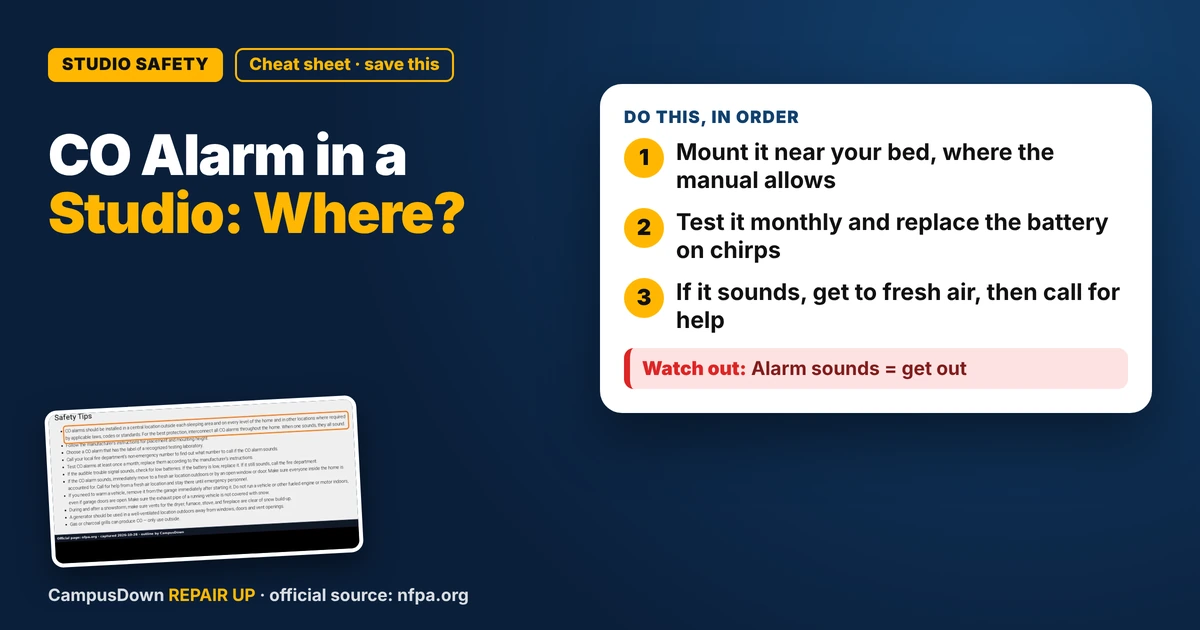
- Mount it near your bed, where the manual allows
- Test it monthly and replace the battery on chirps
- If it sounds, get to fresh air, then call for help
A studio is one room doing five jobs: bedroom, kitchen, office, gym (two dumbbells count), and occasional date-night restaurant. So when you finally buy a carbon monoxide alarm, the question is real: where do you put a CO alarm in a studio when everything is technically "the sleeping area"?
What the fire safety people actually say
The National Fire Protection Association's carbon monoxide page says CO alarms should go in a central location outside each sleeping area, on every level of the home, and anywhere else your local laws or codes require. It also says to follow the manufacturer's instructions for placement and mounting height.
That last part matters more than people think. Different models are designed for different spots, so the little paper insert you threw in the junk drawer is the real rulebook.
Translating that into a studio
In a studio there's no hallway "outside" the bedroom, because the bedroom is the whole place. So the practical reading is: put it where you'd hear it while asleep, in a spot the manual allows, not jammed right next to a cooking appliance or in a steamy bathroom corner if the instructions say to avoid that.
A few studio setups:
- Bed by the window, kitchen on the opposite wall:* somewhere on the wall between them, in the range the manual gives.
- Lofted bed:* near the loft level, since that's where your head is at 3 a.m.
- Plug-in model:* an outlet in the main room that isn't hidden behind the couch or dresser.
If your building has a gas stove, a gas heater, or an attached garage, it's worth asking your landlord what's already installed and whether your local rules require one. Rules vary by city and state.
The chirp vs. the real alarm
NFPA's page splits these up. A trouble signal (usually a chirp) often means low battery, so swap the battery. If it keeps chirping after that, the guidance is to call the fire department. A real alarm is different: get to fresh air outdoors or by an open window or door, make sure everyone is out, and call for help from there.
Also, test it monthly. Put a recurring reminder on your phone right after your rent reminder. Same energy.
Why we skip this stuff
Carbon monoxide has no smell and no color, so there's no "vibe" telling you something's wrong. That's exactly where normalcy bias gets you: nothing bad has happened, so nothing bad will. And because CO stories aren't all over your feed the way viral kitchen fires are, the availability heuristic makes the risk feel smaller than it is.
The science part is simple: CO gets in the way of your blood carrying oxygen, which is why early symptoms feel like flu. NFPA lists things like headaches, dizziness, nausea and shortness of breath. If a whole household feels weird at home and fine outside, that's a red flag.
Pick an alarm without overthinking it
You don't need the fanciest smart model. NFPA says to choose a CO alarm with the label of a recognized testing laboratory. Battery or plug-in with battery backup both work for a lot of renters. Write the install date on the back with a marker so future you knows how old it is.
And please, don't "borrow" the battery for your game controller. We've all thought about it. Using the sunk cost of the alarm as an excuse to never replace it is not the move either; if the manual says it's time, it's time.
Small habits that keep you safe
Never run a grill or generator indoors, even "just for a minute." Don't use the oven to heat the room on a cold night. Keep vents for the stove or heater clear. These are boring habits, but boring is good when it comes to invisible gas.
Picture a future dinner where you finally host someone in your tiny place, candles lit, pasta on, and you're relaxed because the safety stuff is already handled. That's lowkey romantic in its own nerdy way.
Know someone staring at a repair right now? Send this their way.
Pick an app — it just sends the link, nothing else.
Frequently Asked Questions
Where should a CO alarm go in a studio apartment?
Near where you sleep, in a spot the manufacturer's instructions allow. NFPA says outside each sleeping area and on every level.
Can a CO alarm go next to the stove?
Check your model's manual. Many list spots to avoid, so follow the placement and height it gives.
What should I do if my CO alarm goes off?
Get to fresh air outdoors or by an open door or window right away, then call for help from there.
Why does my CO alarm keep chirping?
Often a low battery. Replace it. If it still chirps, NFPA says to call the fire department.