I Switched to Cold Water Laundry and Worried My Clothes Would Stink
Does cold water laundry get clothes clean? What changes when you skip hot water, which loads still need care, and how to read care labels on a budget.
“Almost cried fixing my own house. Learned to read every quote instead.”
Theology · Scripture Cards
Open a scripture card
Already read and shared by 315 people.
 I Am with You
Genesis 28:15
Behold, I am with you, and will keep you, wherever you go, and will bring you again into this land. For I will not leave you until I have…
Read this card
 I Will Put Breath in You
Ezekiel 37:5-6
The Lord Yahweh says to these bones: “Behold, I will cause breath to enter into you, and you will live. I will lay sinews on you, and will…
Read this card
 Listen to Him
Matthew 17:5
While he was still speaking, behold, a bright cloud overshadowed them. Behold, a voice came out of the cloud, saying, “This is my beloved…
Read this card
 Peace, Be Still
Mark 4:39, 41
He awoke and rebuked the wind, and said to the sea, “Peace! Be still!” The wind ceased and there was a great calm. … They were greatly…
Read this card
 Meant for Good
Genesis 50:20
As for you, you meant evil against me, but God meant it for good, to save many people alive, as is happening today.
Read this card
 Look and Live
Numbers 21:8-9
Yahweh said to Moses, “Make a venomous snake, and set it on a pole. It shall happen that everyone who is bitten, when he sees it, shall…
Read this card
 For Such a Time as This
Esther 4:14
For if you remain silent now, then relief and deliverance will come to the Jews from another place, but you and your father’s house will…
Read this card
 Let There Be Light
Genesis 1:3-4
God said, “Let there be light,” and there was light. God saw the light, and saw that it was good. God divided the light from the darkness.
Read this card
Key Takeaways
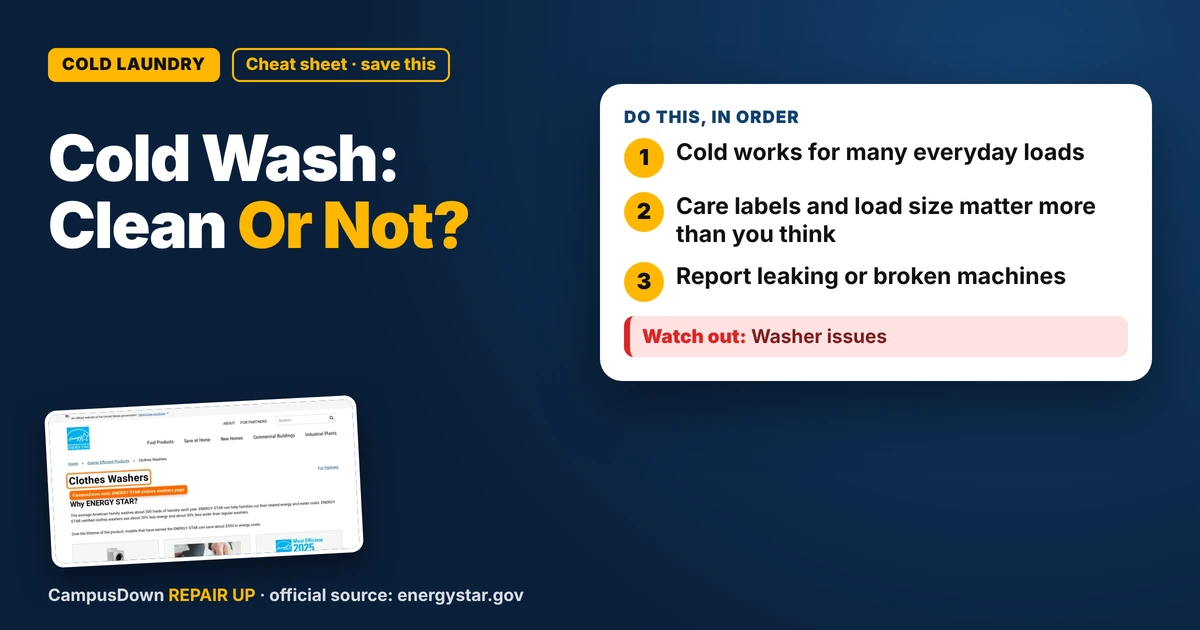
- Cold works for many everyday loads.
- Care labels and load size matter more than you think.
- Report leaking or broken machines.
Laundry is the one chore I can't skip forever, mostly because I own exactly one pair of jeans that fits right. Someone told me to wash in cold to save money, and my first thought was, does cold water laundry get clothes clean, or will I just smell like a damp sock with confidence? Here's what I've worked out.
Why people say to use cold
Heating water takes energy. When the washer uses hot water, your water heater has to work to make it. So skipping hot water on everyday loads is a common money-saving tip. It's also gentler on a lot of fabrics and can help colors last.
Does it actually clean?
For everyday loads, a lot of people find cold works fine, especially with a detergent made for cold or all temperatures. Very greasy, heavily soiled, or sanitizing jobs are where people still reach for warmer water. The care label on the item is your boss here, not me.
Step 1: Read the care tag
- The little washtub symbol has dots or a number for temperature.
- One dot usually means cold, more dots mean warmer.
- If the label says cold only, listen to it.
Step 2: Don't overload
A stuffed washer can't move clothes enough to clean them, no matter the temperature. Leave room for things to tumble. I learned this when I tried to cram two weeks of laundry into one load. The washer basically gave up.
Step 3: Pick the right detergent amount
More soap is not more clean. Too much can leave residue and make clothes feel stiff or smell weird. Follow the line on the cap.
What ENERGY STAR says about washers
The ENERGY STAR clothes washers page covers certified washers designed to use less energy and water than standard models. If you're in a building with old coin-op machines, that's a landlord call, but it's good to know what the label means if you ever buy one.
Why the switch felt scary
We tend to trust what we grew up with, which is status quo bias. One bad load also sticks in your head more than ten fine ones, classic negativity bias. And there's heat transfer behind the whole money angle: heating water means moving energy into it, and that energy isn't free.
When warm or hot still makes sense
- The care label calls for it.
- Bedding or towels when someone in your place has been sick (follow label and health advice).
- Seriously greasy work clothes.
Low-budget laundry habits
Wash full loads, but not stuffed ones. Air-dry what you can to save dryer money and keep stuff from shrinking. Leave the washer door open after a load so it doesn't get musty, if it's your own machine.
If this saved you a headache, it might save a friend one too.
Pick an app — it just sends the link, nothing else.
Frequently Asked Questions
Does cold water laundry get clothes clean?
For many everyday loads, yes, especially with a detergent made for cold. Follow care labels.
When should I use hot water for laundry?
When the care label says so, or for heavily soiled or sanitizing jobs.
Does washing in cold save money?
It can, because heating water takes energy.
Why do my clothes smell after washing?
Overloading, too much detergent, or leaving clothes damp in the washer can all cause smells.