Dishwasher vs Hand Washing Cost: What ENERGY STAR's Numbers Say
Dishwasher vs hand washing cost: ENERGY STAR says a certified dishwasher uses less than half the energy of hand washing. Here's what that means for renters.
“Almost cried fixing my own house. Learned to read every quote instead.”
Theology · Scripture Cards
Open a scripture card
Already read and shared by 315 people.
 Meant for Good
Genesis 50:20
As for you, you meant evil against me, but God meant it for good, to save many people alive, as is happening today.
Read this card
 The Sun of Righteousness
Malachi 4:2
But to you who fear my name shall the sun of righteousness arise with healing in its wings. You will go out and leap like calves of the…
Read this card
 He Revealed His Glory
John 2:11
This beginning of his signs Jesus did in Cana of Galilee, and revealed his glory; and his disciples believed in him.
Read this card
 Twelve Baskets Left Over
John 6:11, 13
Jesus took the loaves, and having given thanks, he distributed to the disciples, and the disciples to those who were sitting down, likewise…
Read this card
 Be Strong and Courageous
Joshua 1:9
Haven’t I commanded you? Be strong and courageous. Don’t be afraid. Don’t be dismayed, for Yahweh your God is with you wherever you go.”
Read this card
 Salvation Is of the Lord
Jonah 2:6, 9
I went down to the bottoms of the mountains. The earth barred me in forever; yet you have brought my life up from the pit, Yahweh my God. ……
Read this card
 The New Covenant in My Blood
Luke 22:19-20
He took bread, and when he had given thanks, he broke and gave it to them, saying, “This is my body which is given for you. Do this in…
Read this card
 I Know That My Redeemer Lives
Job 19:25
But as for me, I know that my Redeemer lives. In the end, he will stand upon the earth.
Read this card
Key Takeaways
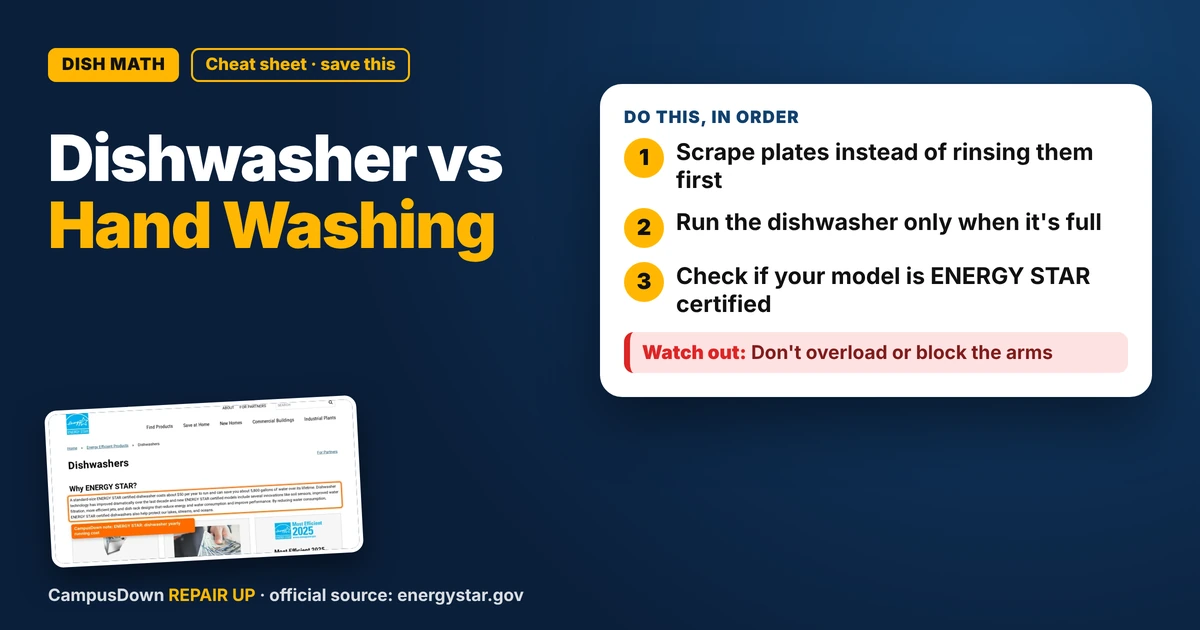
- Scrape plates instead of rinsing them first.
- Run the dishwasher only when it's full.
- Check if your model is ENERGY STAR certified.
Your apartment has a dishwasher, and you've been using it as a drying rack because you assumed hand washing is cheaper. Plot twist. ENERGY STAR has actual numbers on dishwasher vs hand washing cost, and they favor the machine, at least for certified models.
What ENERGY STAR says
From ENERGY STAR's dishwasher page:
| Claim | ENERGY STAR figure |
|---|---|
| Yearly cost to run a standard certified dishwasher | About $50 |
| Energy vs hand washing | Less than half |
| Water saved vs hand washing | 8,400 gallons per year |
| Utility savings vs hand washing | About $220 per year |
| Time saved | Over 230 hours per year |
These are ENERGY STAR's averages for new certified models. Your bills depend on your rates, your habits and your machine.
Does this apply to my old rental dishwasher?
Maybe, maybe not. The figures are for new ENERGY STAR certified models. An older machine might use more. Look up your model number to see if it's certified, or check for a yellow EnergyGuide label in the manual.
How hand washing adds up
Hand washing usually means running hot water for a while. That hot water is heated by your water heater, which uses energy. It's heat transfer going right down the drain. If you pay for hot water separately, that's where the cost shows up.
A habit check
| Habit | Better move |
|---|---|
| Pre-rinsing everything | Scrape food off instead |
| Running half loads | Wait for a full load |
| Hand washing every pan | Load what's dishwasher-safe |
| Hot water running while scrubbing | Fill a basin instead |
ENERGY STAR notes scraping uses a fraction of the water needed to hand rinse.
The money brain
The dishwasher feels like a luxury, hand washing feels free. That's mental accounting at work. If bills are tight, that's energy poverty, and using the dishwasher right may help.
When the dishwasher is broken
If it leaks, doesn't drain or leaves dishes gritty, check the filter if the manual says that's a user task. Otherwise report it in writing to your landlord. Don't open panels on a rental appliance.
Loading tips that actually matter
Put plates facing the center so the spray reaches them. Cups and bowls go upside down on the top rack. Keep tall stuff from blocking the detergent door. Plastic containers usually belong on top, away from the heating element, but check the bottom of the container for a dishwasher-safe mark. Don't nest spoons together in the basket; mix them with forks so water gets between them. If dishes come out cloudy or gritty, look at the manual for the filter cleaning steps before blaming the machine.
Final thought
ENERGY STAR's numbers favor a certified dishwasher over hand washing for energy, water and time. Scrape, don't rinse, run full loads and use the sensor cycle.
Know someone staring at a repair right now? Send this their way.
Pick an app — it just sends the link, nothing else.
Frequently Asked Questions
Is a dishwasher cheaper than hand washing?
ENERGY STAR says a certified dishwasher uses less than half the energy of hand washing and can cut utility bills by about $220 a year.
How much does a dishwasher cost to run?
ENERGY STAR says a standard certified model costs about $50 per year to run.
Should I pre-rinse dishes?
ENERGY STAR suggests scraping instead, which uses a fraction of the water.
Do these numbers apply to old dishwashers?
They're for new certified models. Older machines may use more.