Energy Tax Credits After 2025: What Changed and What Renters Can Still Do
ENERGY STAR says the federal home energy tax credits ran through Dec 31, 2025. Here's what that means in 2026 and what renters can still do to cut energy bills.
“Almost cried fixing my own house. Learned to read every quote instead.”
Theology · Scripture Cards
Open a scripture card
Already read and shared by 315 people.
 The Lord Will Fight for You
Exodus 14:13-14
Moses said to the people, “Don’t be afraid. Stand still, and see the salvation of Yahweh, which he will work for you today; for you will…
Read this card
 Until He Finds It
Luke 15:4, 6
“Which of you men, if you had one hundred sheep and lost one of them, wouldn’t leave the ninety-nine in the wilderness and go after the one…
Read this card
 Surely I Will Be with You
Judges 6:16
Yahweh said to him, “Surely I will be with you, and you shall strike the Midianites as one man.”
Read this card
 Be Strong and Courageous
Joshua 1:9
Haven’t I commanded you? Be strong and courageous. Don’t be afraid. Don’t be dismayed, for Yahweh your God is with you wherever you go.”
Read this card
 I Am with You Always
Matthew 28:20
teaching them to observe all things that I commanded you. Behold, I am with you always, even to the end of the age.” Amen.
Read this card
 Look and Live
Numbers 21:8-9
Yahweh said to Moses, “Make a venomous snake, and set it on a pole. It shall happen that everyone who is bitten, when he sees it, shall…
Read this card
 The Sun of Righteousness
Malachi 4:2
But to you who fear my name shall the sun of righteousness arise with healing in its wings. You will go out and leap like calves of the…
Read this card
 A Fourth Walking in the Fire
Daniel 3:25
He answered, “Look, I see four men loose, walking in the middle of the fire, and they are unharmed. The appearance of the fourth is like a…
Read this card
Key Takeaways
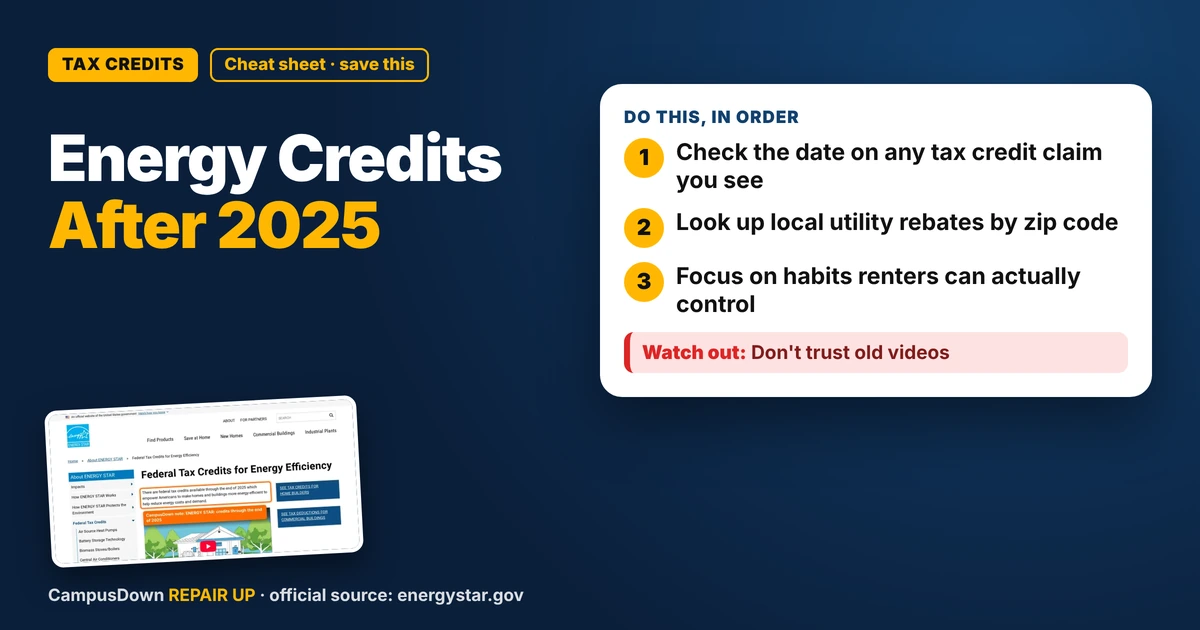
- Check the date on any tax credit claim you see.
- Look up local utility rebates by zip code.
- Focus on habits renters can actually control.
You saw a TikTok saying you can get 30% back on a heat pump. Then someone in the comments said it ended. So what's the deal with energy tax credits after 2025? Here's what ENERGY STAR's own page says, and what it means if you're renting in 2026.
I'm not a tax pro. For your actual return, check IRS guidance or a tax preparer.
What the ENERGY STAR page says
ENERGY STAR's federal tax credits page says that through December 31, 2025, federal income tax credits were available to homeowners, allowing up to $3,200 to lower the cost of energy efficient home upgrades by up to 30 percent. It says the Residential Clean Energy credit for things like rooftop solar, geothermal heat pumps and battery storage was also ending December 31, 2025.
The page also says credits are claimed with IRS Form 5695 for the tax year the upgrades were made.
What that means in 2026
Based on that page, upgrades made in 2026 don't fall inside the window it describes. If you made a qualifying upgrade in 2025, you'd claim it on your 2025 return. Rules can change, so check the IRS for the current status before you plan around any credit.
The credit amounts it listed (for 2025)
| Credit | Listed amount |
|---|---|
| Heat pumps, heat pump water heaters, biomass | 30% up to $2,000 |
| Other efficiency improvements | 30% up to $1,200 |
| Combined in one tax year | Up to $3,200 |
Renters: what's still in your control
Most of those credits were aimed at homeowners making upgrades. As a renter in 2026, your levers are smaller but real:
- Check for local utility rebates. ENERGY STAR has a rebate finder by zip code.
- Pick ENERGY STAR products for things you buy yourself, like a room AC or a fan.
- Ask your landlord about efficiency upgrades. Frame it as lower bills and happier tenants.
- Use the cheap habits: filters, thermostat settings, unplugging stuff.
The money psychology
People treat a tax credit like free money and a utility bill like a tax. That's mental accounting. Your best savings may come from boring habits. Behind it all is basic heat transfer: drafts and poor insulation leak what you paid for. And for many students, energy poverty is real, so every bit counts.
A small homework assignment
Pull up your last three utility bills. Write down the totals and the usage numbers, not just the dollars. Then pick one habit to change for a month and compare. It's not as exciting as a tax credit, but nobody can take it away from you with a policy change.
Final thought
ENERGY STAR's page puts the end of those federal credits at December 31, 2025. For 2026, check the IRS, look for local rebates and focus on what renters can control.
Know someone staring at a repair right now? Send this their way.
Pick an app — it just sends the link, nothing else.
Frequently Asked Questions
Did federal energy tax credits end after 2025?
ENERGY STAR's page says the credits were available through December 31, 2025. Check the IRS for current rules.
How were the credits claimed?
ENERGY STAR says with IRS Form 5695 for the tax year the upgrades were made.
Can renters still save on energy in 2026?
Yes, through local utility rebates, efficient products you buy and everyday habits.
Where do I find local rebates?
ENERGY STAR offers a rebate finder by zip code, and your utility's website may list programs.