I Hung Way Too Many Posters. Here's How I Patched the Holes Before Move-Out
Need to fix small nail holes before moving out? Here's how to patch tiny holes in drywall, when to leave it alone, and what to ask your landlord first.
“Almost cried fixing my own house. Learned to read every quote instead.”
Theology · Scripture Cards
Open a scripture card
Already read and shared by 315 people.
 Bread from Heaven
Exodus 16:4
Then Yahweh said to Moses, “Behold, I will rain bread from the sky for you, and the people shall go out and gather a day’s portion every…
Read this card
 Salvation Is of the Lord
Jonah 2:6, 9
I went down to the bottoms of the mountains. The earth barred me in forever; yet you have brought my life up from the pit, Yahweh my God. ……
Read this card
 Let There Be Light
Genesis 1:3-4
God said, “Let there be light,” and there was light. God saw the light, and saw that it was good. God divided the light from the darkness.
Read this card
 He Revealed His Glory
John 2:11
This beginning of his signs Jesus did in Cana of Galilee, and revealed his glory; and his disciples believed in him.
Read this card
 A Fourth Walking in the Fire
Daniel 3:25
He answered, “Look, I see four men loose, walking in the middle of the fire, and they are unharmed. The appearance of the fourth is like a…
Read this card
 Surely I Will Be with You
Judges 6:16
Yahweh said to him, “Surely I will be with you, and you shall strike the Midianites as one man.”
Read this card
 I Am the Light of the World
John 8:12
Again, therefore, Jesus spoke to them, saying, “I am the light of the world. He who follows me will not walk in the darkness, but will have…
Read this card
 Listen to Him
Matthew 17:5
While he was still speaking, behold, a bright cloud overshadowed them. Behold, a voice came out of the cloud, saying, “This is my beloved…
Read this card
Key Takeaways
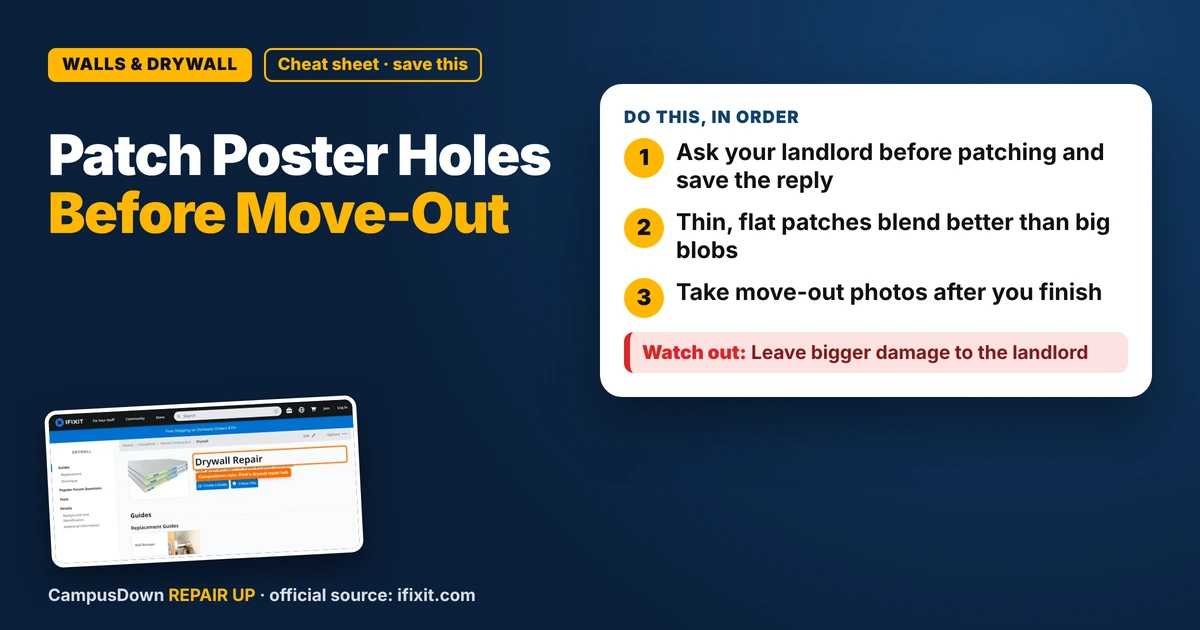
- Ask your landlord before patching and save the reply.
- Thin, flat patches blend better than big blobs.
- Take move-out photos after you finish.
Move-out week hits and suddenly you notice every nail and thumbtack hole you made over the year. If you're wondering how to fix small nail holes before moving out, good news: tiny holes in drywall are one of the easiest DIY repairs. But check your lease first.
Ask before you patch
Some leases say small nail holes are normal wear and tear. Some landlords want you to leave them so their painter can handle it. A bad patch with the wrong color can look worse than a tiny hole. Send a quick message to your landlord asking what they prefer, and keep their reply.
Taking photos at move-in and move-out is your best friend here. If you didn't take move-in photos, start now with your move-out ones.
What you need
- A small tub of spackle or lightweight patching compound
- A putty knife, or an old gift card in a pinch
- Fine sandpaper
- A damp cloth
The iFixit drywall hub has guides for patching holes of different sizes, from nail holes to bigger damage. It's handy for seeing the right technique before you start smearing.
How to patch a nail hole
- Pull out any nail or anchor* gently. If a plastic anchor won't come out, push it slightly into the wall so it sits below the surface.
- Press a little spackle into the hole* with the putty knife.
- Scrape it flat* across the surface so there's barely any extra.
- Let it dry* according to the label.
- Lightly sand* until it's smooth and level with the wall.
- Wipe the dust* with a damp cloth.
Less is more. A thin, flat patch blends better than a giant blob. This is where the Dunning-Kruger effect loves to show up: one video and suddenly you're slathering spackle like a contractor. Go slow.
Paint or no paint?
White spackle on a white wall can still look different, especially in daylight. If your landlord gave you the paint color, a small touch-up can help. If you don't know the exact color, ask before painting. Mismatched paint patches can stand out more than the holes.
Make it part of your move-out plan
Patching takes a little drying time, so don't save it for the last hour. The planning fallacy says you'll think it takes ten minutes. It doesn't, once you count drying and sanding. Make a move-out checklist, and do the walls a few days early.
The IKEA effect is also real: you'll feel proud of your patch job even if it's not perfect, so get a second opinion from a friend in good light.
If this saved you a headache, it might save a friend one too.
Pick an app — it just sends the link, nothing else.
Frequently Asked Questions
Should I fix nail holes before moving out?
Ask your landlord first. Some treat small nail holes as normal wear and tear and prefer you leave them.
What do I use to fill small nail holes?
Spackle or lightweight patching compound, a putty knife, and fine sandpaper.
Do I need to paint over spackle?
It depends. If you don't know the exact paint color, ask before touching up.
What damage should I not patch myself?
Large holes, cracks, and water damage are best reported to the landlord.