Home Improvement Cost Estimator I Can Actually Use on a Ramen Budget
A home improvement cost estimator you fill in yourself: materials, labor, tools, permits and a buffer, plus how to turn real quotes into a number you trust.
“Almost cried fixing my own house. Learned to read every quote instead.”
Theology · Scripture Cards
Open a scripture card
Already read and shared by 315 people.
 While He Was Still a Long Way Off
Luke 15:20, 22
“He arose and came to his father. But while he was still far off, his father saw him and was moved with compassion, and ran, fell on his…
Read this card
 Until He Finds It
Luke 15:4, 6
“Which of you men, if you had one hundred sheep and lost one of them, wouldn’t leave the ninety-nine in the wilderness and go after the one…
Read this card
 Wings like Eagles
Isaiah 40:31
but those who wait for Yahweh will renew their strength. They will mount up with wings like eagles. They will run, and not be weary. They…
Read this card
 The Lord Is My Shepherd
Psalm 23:1, 4
Yahweh is my shepherd; I shall lack nothing. … Even though I walk through the valley of the shadow of death, I will fear no evil, for you…
Read this card
 Peace, Be Still
Mark 4:39, 41
He awoke and rebuked the wind, and said to the sea, “Peace! Be still!” The wind ceased and there was a great calm. … They were greatly…
Read this card
 He Is Not Here, He Has Risen
Matthew 28:5-6
The angel answered the women, “Don’t be afraid, for I know that you seek Jesus, who has been crucified. He is not here, for he has risen…
Read this card
 For Such a Time as This
Esther 4:14
For if you remain silent now, then relief and deliverance will come to the Jews from another place, but you and your father’s house will…
Read this card
 Water from the Rock
Exodus 17:6
Behold, I will stand before you there on the rock in Horeb. You shall strike the rock, and water will come out of it, that the people may…
Read this card
Key Takeaways
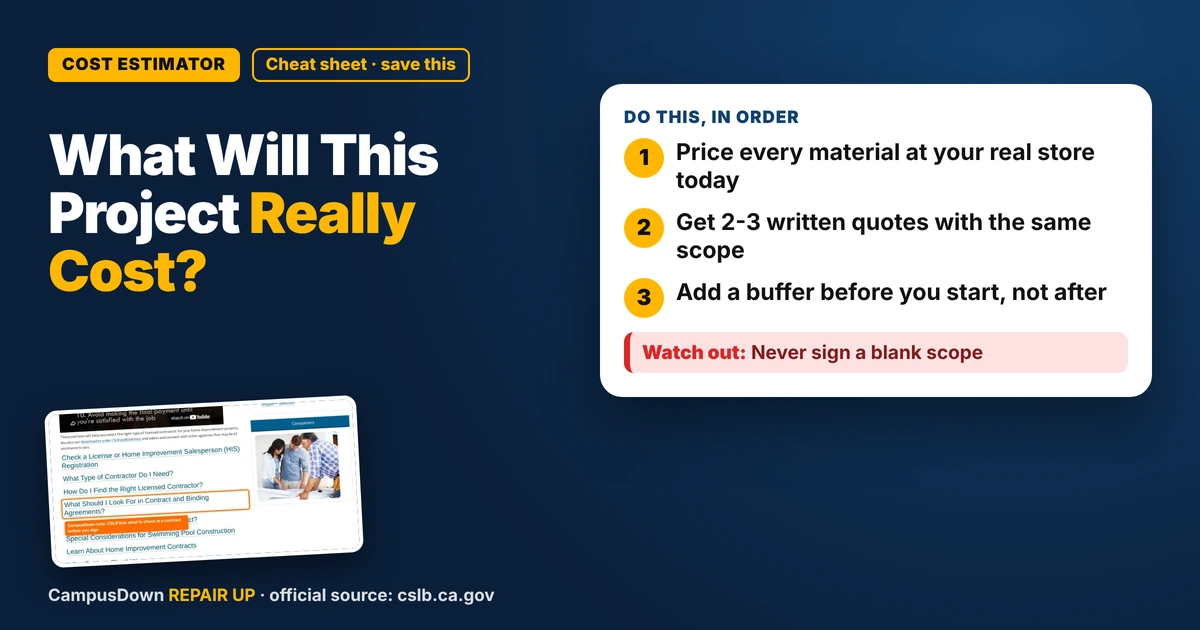
- Price every material at your real store today.
- Get 2-3 written quotes with the same scope.
- Add a buffer before you start, not after.
Every home improvement cost estimator online wants to spit out one magic number before it knows anything about your place. I get the appeal. When you're a broke college guy staring at a sad bathroom, you want someone to just tell you "it's this much, bro." But a number with no inputs is a vibe, not an estimate. So here's the fill-in-yourself version I use for my own apartment projects, the one that works whether the job is a ten-dollar caulk refresh or something you need the landlord or a pro for.
Why a "national average" isn't your estimate
Prices change by city, by season, by how old the building is, and by what's hiding behind the wall. A big average also messes with your head. Once you see one figure, every quote gets compared to it, which is the anchoring effect doing its thing. A quote can look "expensive" only because some random website planted a number in your brain first.
So instead of hunting for the perfect average, build your own estimate from parts you can actually check: the store shelf, the quotes in your inbox, and your own calendar.
The five-line estimator worksheet
Grab a notes app or the home repair budget calculator on this site, and fill in five lines:
- Materials.* List every item with quantity. Look up the real price at the store you'll actually shop at, today. Write the link or a photo of the tag next to it.
- Tools.* Only tools you don't own. Next to each, write "buy", "borrow" or "rent". Borrowing from a neighbor or a campus maker space is a legit line item worth zero.
- Labor.* If you're hiring, this line comes from written quotes, not guesses. If you're doing it yourself, write your hours anyway.
- Permits and fees.* Some work needs a permit and some doesn't. Call your local building department or check its website. For renters, this line usually belongs to the landlord.
- Buffer.* A percentage you pick before you start, on top of lines 1 to 4. Surprises are normal: rotten wood, the wrong size fitting, a second trip to the store.
Total = materials + tools + labor + permits, then multiply by (1 + your buffer). That's it. No secret sauce.
Your time is a cost too
Say a weekend project eats twelve hours. Those are hours you could have worked a shift, studied for that exam, or finally gone on that date you keep "rescheduling." That's opportunity cost, and it's the line most DIY videos skip. I'm not saying hire out everything. I'm saying write the hours down, because "free labor" is a myth when you're the labor.
It also helps to keep project money in its own bucket. I keep a tiny "apartment fixes" envelope in my banking app. That's mental accounting, and while it's technically a bias, it stops me from raiding grocery money for paint.
Turning quotes into a real number
If any part of the job needs a pro, the labor line is only as good as the quotes. A few rules that keep it honest:
- Get at least two or three written quotes for the same scope. Same list of work, same materials.
- Ask each one to separate materials, labor and any trip or disposal fees.
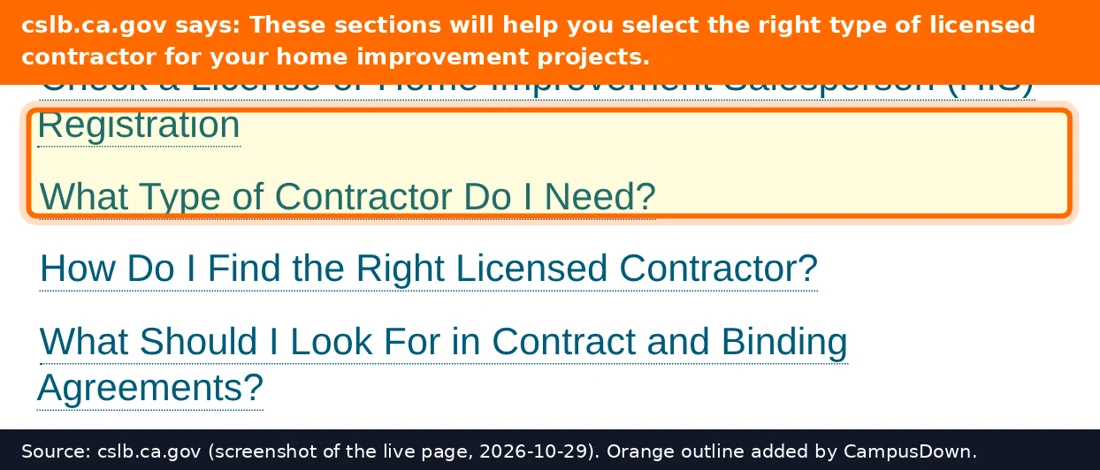
- Check the license before you compare prices. In California, the Contractors State License Board has a whole section on how to hire a licensed contractor, including what to look for in a contract. Other states have their own licensing boards.
- Put the quotes side by side in the contractor comparison template so you compare scope, not just the bottom line.
Renter reality check
If you rent, a lot of "home improvement" is actually the landlord's call. Painting, fixtures, anything touching plumbing or wiring: read your lease and ask in writing first. Your estimator is still useful here, because a clean, itemized plan is way easier for a landlord to approve than "can I fix the bathroom?" Sometimes they even cover it, because you just did the planning for them.
Projects that are almost always renter-safe: removable shelves, swapping a shower head and keeping the old one, adding weatherstripping, plug-in lighting. Projects to never DIY: gas lines, electrical panels, anything structural.
A sample filled-in worksheet (hypothetical)
Say you want to refresh a small bedroom with removable wallpaper on one wall and a new curtain rod. Your sheet might look like this:
| Line | What goes here | Where the number comes from |
|---|---|---|
| Materials | wallpaper rolls, rod, anchors | store website, same day |
| Tools | level, stud finder | borrow from a friend |
| Labor | your hours | your calendar |
| Permits | none for this one | landlord OK in writing |
| Buffer | your chosen percent | decided before you start |
Notice there are no made-up prices in that table. The point is the method, and the numbers come from your own receipts and quotes.
Final thought
A good estimator isn't a crystal ball. It's a checklist that makes you look up every real price before you spend a cent. Do that, and the final number stops being scary and starts being a plan. Future you, hosting a tiny dinner in a room that finally looks nice, says thanks.
Know someone staring at a repair right now? Send this their way.
Pick an app — it just sends the link, nothing else.
Frequently Asked Questions
How do I estimate home improvement costs myself?
List materials, tools, labor, permits and a buffer. Price materials at the actual store you'll use and get written quotes for any labor.
Are online cost estimators accurate?
They can give a rough idea, but local prices, building age and hidden damage change the total. Use written quotes for your own job.
How big should my buffer be?
Pick a percentage before you start based on how much you don't know about the job. Older buildings and hidden areas usually deserve a bigger one.
Do renters need landlord permission for improvements?
Usually yes for anything permanent. Read your lease and ask in writing before you start.