Home Painting Calculator: How Many Gallons for Your Room (and How Many Coats)
A home painting calculator you can do on your phone: measure walls, subtract doors and windows, count coats, and use the can's coverage to get gallons.
“Almost cried fixing my own house. Learned to read every quote instead.”
Theology · Scripture Cards
Open a scripture card
Already read and shared by 315 people.
 While He Was Still a Long Way Off
Luke 15:20, 22
“He arose and came to his father. But while he was still far off, his father saw him and was moved with compassion, and ran, fell on his…
Read this card
 Not My Will, but Yours
Luke 22:42
saying, “Father, if you are willing, remove this cup from me. Nevertheless, not my will, but yours, be done.”
Read this card
 Look and Live
Numbers 21:8-9
Yahweh said to Moses, “Make a venomous snake, and set it on a pole. It shall happen that everyone who is bitten, when he sees it, shall…
Read this card
 Your God, My God
Ruth 1:16
Ruth said, “Don’t urge me to leave you, and to return from following you, for where you go, I will go; and where you stay, I will stay.…
Read this card
 God Shut the Lions’ Mouths
Daniel 6:22
My God has sent his angel, and has shut the lions’ mouths, and they have not hurt me, because innocence was found in me before him; and…
Read this card
 Take Heart, It Is I
Matthew 14:27, 31
But immediately Jesus spoke to them, saying, “Cheer up! It is I! Don’t be afraid.” … Immediately Jesus stretched out his hand, took hold of…
Read this card
 I AM WHO I AM
Exodus 3:14
God said to Moses, “I AM WHO I AM,” and he said, “You shall tell the children of Israel this: ‘I AM has sent me to you.’ ”
Read this card
 The God Who Brought You Out
Exodus 20:2
“I am Yahweh your God, who brought you out of the land of Egypt, out of the house of bondage.
Read this card
Key Takeaways
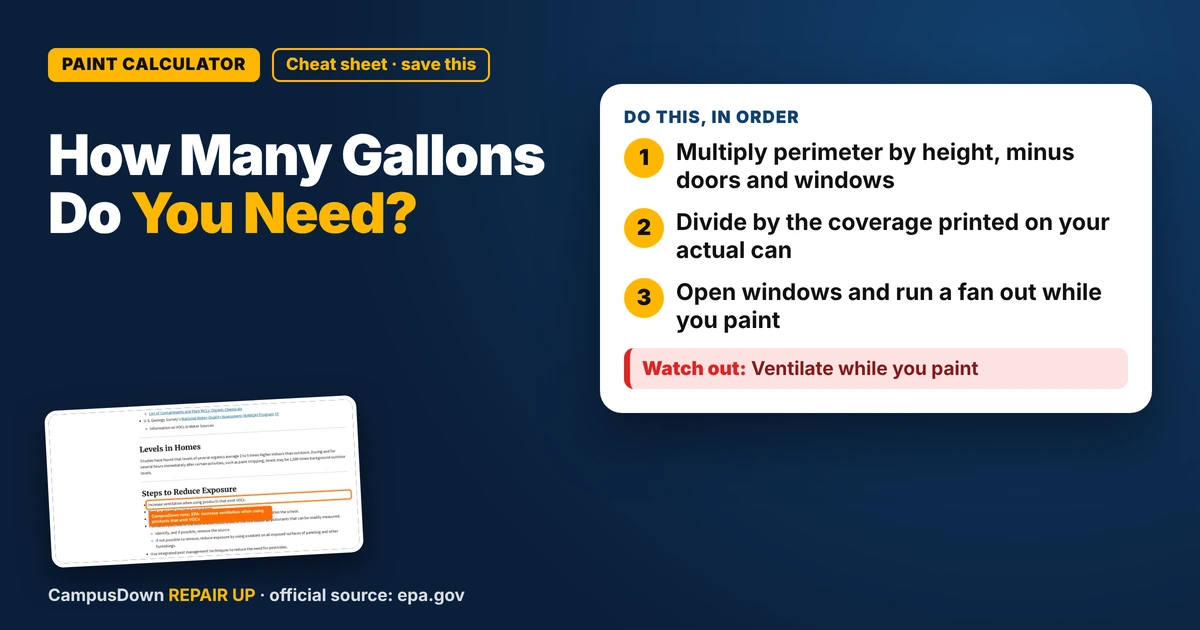
- Multiply perimeter by height, minus doors and windows.
- Divide by the coverage printed on your actual can.
- Open windows and run a fan out while you paint.
The worst feeling in DIY painting is running out of paint with one wall left, at 9 p.m., when the store closes at 9. The second worst is having three extra gallons living in your closet forever. A home painting calculator fixes both, and you don't need an app. You need a tape measure, the label on the can, and two minutes of math.
Step 1: Measure the walls
For each wall, measure width and height. Multiply them. Add all the walls together. For a simple rectangle room, the shortcut is:
Wall area = (perimeter of the room) × (wall height)
Perimeter is just all four wall widths added up.
Step 2: Subtract doors and windows
Measure each door and window and subtract its area. Small ones barely matter, but big closet doors and sliding glass doors do. If you're painting the doors too, count them as their own little project.
Step 3: Count coats
Two coats is a common plan, especially if you're changing colors. Going from dark to light, or covering patched spots, might need primer first. Check what the paint brand says on its label or website.
Total area to cover = (wall area − doors and windows) × coats
Step 4: Use the coverage on the can
Every paint can prints how much area one gallon covers. That number varies by product and by how rough the wall is, so use the label of the paint you're actually buying, not a number from some random blog (including this one).
Gallons = total area to cover ÷ coverage per gallon
Round up. If you land between a quart and a gallon, it can be cheaper to buy the gallon, but compare prices on the day.
Want the math done for you? Plug your measurements into the painting cost calculator.
Ceilings and trim are separate
Ceilings use different paint usually, and trim often uses a different sheen. Do them as separate lines: ceiling area is just length × width of the room. Trim is easier to estimate by linear length and a small can.
Air out the room
Paint is one of the household products EPA names when it talks about VOCs. EPA's page on volatile organic compounds and indoor air quality says to increase ventilation when using products that emit VOCs, and to follow label directions such as using products in a well-ventilated area. In a tiny apartment, that means windows open, a fan pointing out, and maybe not sleeping in that room the first night if you can avoid it.
Renters: ask first
Most leases have something to say about painting. Ask your landlord in writing, and ask whether they want it returned to the original color when you move out. If so, add that repaint to your plan now, or you'll be doing math again in May.
Why it always takes longer
You'll think it's a two-hour job. It won't be. Taping, moving furniture, drying between coats and cleanup eat time, a textbook case of the planning fallacy. Give yourself a full day for one room.
Also: you'll probably love the result more than an equally good wall someone else painted. That's the IKEA effect, and honestly it's earned. And don't let a contractor's sample price you saw earlier stick in your head as "the" price, that's anchoring.
Final thought
Measure, subtract, count coats, divide by the can's coverage, round up. That's the whole home painting calculator. The rest is good tape, open windows and patience.
If this saved you a headache, it might save a friend one too.
Pick an app — it just sends the link, nothing else.
Frequently Asked Questions
How do I calculate how much paint I need?
Multiply the room perimeter by wall height, subtract doors and windows, multiply by coats, then divide by the coverage on the paint can label.
How many coats of paint does a room need?
Two coats is common, especially when changing colors. Check the paint label and consider primer for dark-to-light changes.
Should I include the ceiling in my wall calculation?
No. Measure the ceiling separately as length times width, since it often uses a different paint.
Is it safe to sleep in a freshly painted room?
Follow the can's directions and ventilate well. EPA advises increasing ventilation when using products that emit VOCs.