Half a Can of Paint and Dead Batteries: Where Does It Go?
Household hazardous waste like paint, cleaners, oil, and batteries can't just go in the trash. Here's EPA's take on storage, drop-offs, and collection days.
“Almost cried fixing my own house. Learned to read every quote instead.”
Theology · Scripture Cards
Open a scripture card
Already read and shared by 315 people.
 Daughter, Your Faith Has Healed You
Mark 5:34
He said to her, “Daughter, your faith has made you well. Go in peace, and be cured of your disease.”
Read this card
 Your Faith Has Made You Well
Mark 10:52
Jesus said to him, “Go your way. Your faith has made you well.” Immediately he received his sight and followed Jesus on the way.
Read this card
 Hosanna to the Son of David
Matthew 21:9
The multitudes who went in front of him, and those who followed, kept shouting, “Hosanna to the son of David! Blessed is he who comes in…
Read this card
 Take Heart, It Is I
Matthew 14:27, 31
But immediately Jesus spoke to them, saying, “Cheer up! It is I! Don’t be afraid.” … Immediately Jesus stretched out his hand, took hold of…
Read this card
 I Am the Light of the World
John 8:12
Again, therefore, Jesus spoke to them, saying, “I am the light of the world. He who follows me will not walk in the darkness, but will have…
Read this card
 I Know That My Redeemer Lives
Job 19:25
But as for me, I know that my Redeemer lives. In the end, he will stand upon the earth.
Read this card
 Until He Finds It
Luke 15:4, 6
“Which of you men, if you had one hundred sheep and lost one of them, wouldn’t leave the ninety-nine in the wilderness and go after the one…
Read this card
 Twelve Baskets Left Over
John 6:11, 13
Jesus took the loaves, and having given thanks, he distributed to the disciples, and the disciples to those who were sitting down, likewise…
Read this card
Key Takeaways
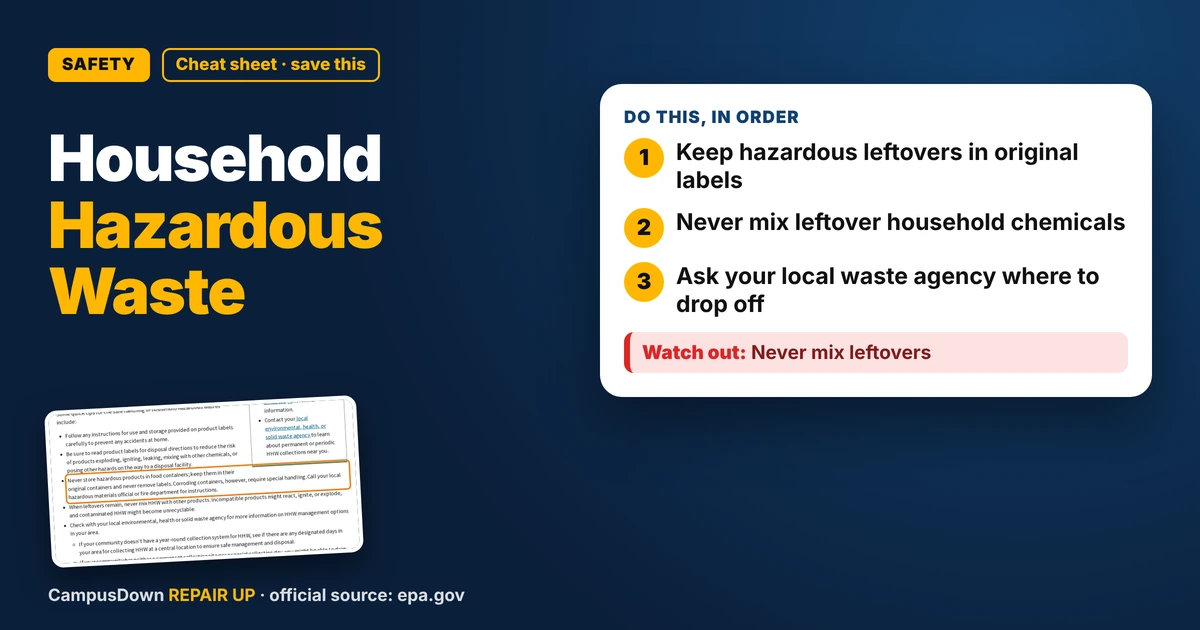
- Keep hazardous leftovers in original labels
- Never mix leftover household chemicals
- Ask your local waste agency where to drop off
Move-out week is when you find it: half a can of paint, a bottle of drain cleaner, a sad bag of dead batteries, and some mystery spray from the previous tenant. Dumping it all in the dumpster is tempting. But household hazardous waste disposal has its own rules, and EPA's guidance is pretty clear about the basics.
What counts as HHW
EPA's household hazardous waste page says leftover products that can catch fire, react, or explode, or that are corrosive or toxic, count as household hazardous waste. It names paints, cleaners, oils, batteries, and pesticides as examples of products that can contain hazardous ingredients and need special care when you get rid of them.
What not to do
EPA lists improper disposal as pouring these products down the drain, on the ground, or into storm sewers, and in some cases putting them out with the trash. It says that can pollute the environment, threaten health, injure sanitation workers, and mess up septic tanks or wastewater treatment systems.
Storing it until drop-off day
EPA's quick tips, in student terms:
- Keep products in their original containers with the labels on. No pouring bleach into an old Gatorade bottle.
- Read the label for disposal directions before you move it.
- Don't mix leftovers together to "save space."
- Even empty containers can hold leftover chemicals, so handle those carefully too.
- If a container is corroding, EPA says to call your local hazardous materials official or fire department for instructions.
Where it actually goes
This depends on where you live, and I'm not going to guess your city's rules. EPA's route:
- Contact your local environmental, health, or solid waste agency about permanent or periodic HHW collections.
- If there's no year-round site, look for special collection days at a central location.
- If neither exists, some local businesses may take certain products. EPA's example: some garages accept used motor oil for recycling.
EPA also suggests searching "household hazardous waste" with your zip code in the Earth911 database.
Buy less next time
EPA's last tip is the one that saves money: buy fewer products with hazardous ingredients. It also lists simple homemade alternatives, like a glass cleaner made from a tablespoon of vinegar or lemon juice in a quart of water.
Why it piles up
Leaving the bottle for the next tenant pushes the cost onto someone else. Economists call that an externality. When everyone in the building does it, the shared dumpster becomes a tragedy of the commons. And procrastination is why that half-can of paint survives three moves.
Know someone staring at a repair right now? Send this their way.
Pick an app — it just sends the link, nothing else.
Frequently Asked Questions
What is household hazardous waste?
EPA says leftover products that can catch fire, react, explode, or are corrosive or toxic, like paints, cleaners, oils, batteries, and pesticides.
Can I pour old cleaners down the drain?
EPA lists pouring HHW down drains as improper disposal that can harm wastewater systems.
How should I store HHW?
In original containers with labels on, never in food containers, and never mixed.
Where do I drop it off?
Ask your local solid waste agency about collection sites or days, or search Earth911 by zip code.