Light Switch Warm to the Touch: When to Worry
Light switch feeling warm? Learn when slight warmth from a dimmer can be normal, which signs mean stop, and what to tell your landlord or an electrician.
“Almost cried fixing my own house. Learned to read every quote instead.”
Theology · Scripture Cards
Open a scripture card
Already read and shared by 315 people.
 Unto Us a Child Is Born
Isaiah 9:6
For a child is born to us. A son is given to us; and the government will be on his shoulders. His name will be called Wonderful Counselor…
Read this card
 Daughter, Your Faith Has Healed You
Mark 5:34
He said to her, “Daughter, your faith has made you well. Go in peace, and be cured of your disease.”
Read this card
 Until He Finds It
Luke 15:4, 6
“Which of you men, if you had one hundred sheep and lost one of them, wouldn’t leave the ninety-nine in the wilderness and go after the one…
Read this card
 He Revealed His Glory
John 2:11
This beginning of his signs Jesus did in Cana of Galilee, and revealed his glory; and his disciples believed in him.
Read this card
 Peace, Be Still
Mark 4:39, 41
He awoke and rebuked the wind, and said to the sea, “Peace! Be still!” The wind ceased and there was a great calm. … They were greatly…
Read this card
 Hosanna to the Son of David
Matthew 21:9
The multitudes who went in front of him, and those who followed, kept shouting, “Hosanna to the son of David! Blessed is he who comes in…
Read this card
 The Sun of Righteousness
Malachi 4:2
But to you who fear my name shall the sun of righteousness arise with healing in its wings. You will go out and leap like calves of the…
Read this card
 Let There Be Light
Genesis 1:3-4
God said, “Let there be light,” and there was light. God saw the light, and saw that it was good. God divided the light from the darkness.
Read this card
Key Takeaways
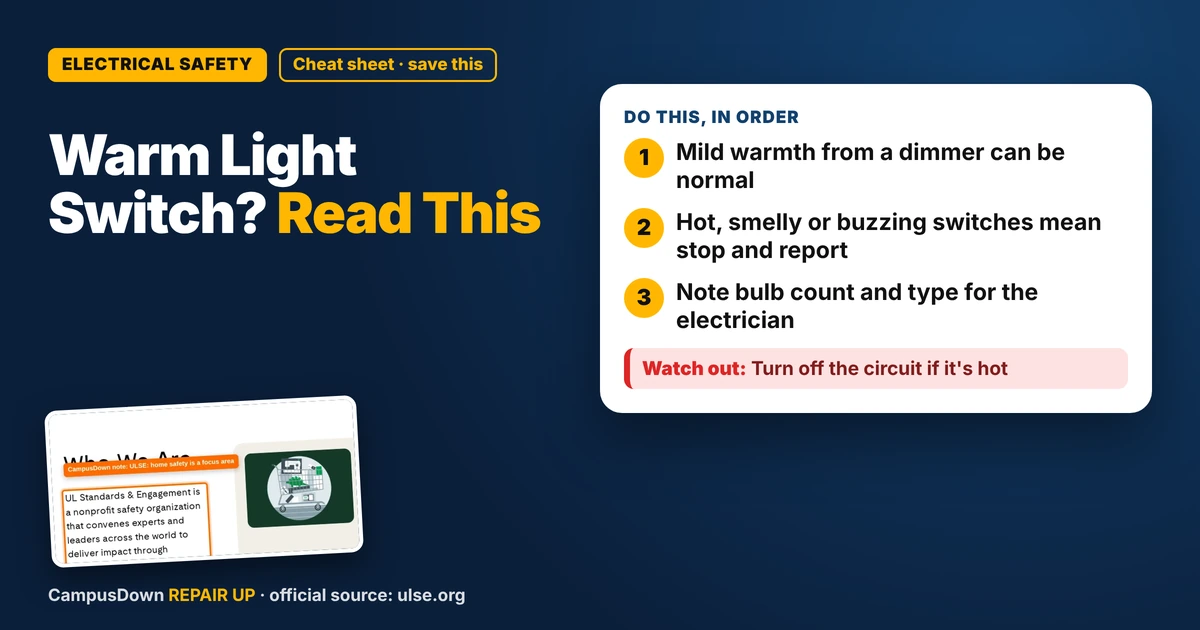
- Mild warmth from a dimmer can be normal
- Hot, smelly or buzzing switches mean stop and report
- Note bulb count and type for the electrician
I flipped the hallway light at night and the switch plate felt like it had just finished a workout. A light switch warm to the touch made me picture my apartment going up in smoke while I slept. Here's what I learned before panicking all the way.
Dimmers vs regular switches
Dimmer switches turn some energy into heat as they work, so slight warmth from a dimmer can be normal, depending on the model and the load. Regular on-off switches usually shouldn't feel warm. The manual or packaging for a dimmer often lists the max load it can handle.
Signs it's not normal
- Hot enough that you don't want to keep your hand on it
- Burning smell or discoloration on the plate
- Buzzing, crackling or flickering lights
- A regular switch that feels warm
Why switches heat up
A loose wire screw or worn contacts in a switch can create resistance. Ohm's law ties current and resistance to voltage, and resistance at a bad connection produces heat. Overloading a dimmer with more bulbs than it's rated for can do it too.
Safety orgs
UL Standards & Engagement calls itself a nonprofit safety organization and works on standards and safety education. That homepage doesn't have specific advice about warm switches, so for diagnosis you need an electrician who can open the box.
Brain traps
"It's been warm since I moved in, so it must be fine." That's normalcy bias. "Wiring problems happen in old houses, not my place." That's optimism bias. Neither one has an electrician's license.
Renters
Switches and wiring belong to the building. Message your landlord with:
- Which switch and what it controls
- Whether it's a dimmer
- How warm it gets and when
- Any smells, sounds or flickering
Include a photo of the switch plate. Discoloration shows up surprisingly well on camera.
Hypothetical
Hypothetical: your dimmer feels mildly warm after an hour of use, with no smell or sound. That might be normal for that dimmer, but the electrician should confirm. A regular switch that feels warm is more concerning.
LED bulbs and dimmers
Some dimmers aren't designed for LED bulbs, which can lead to flicker or buzzing. If you swapped to LEDs recently, mention it in your message.
If this saved you a headache, it might save a friend one too.
Pick an app — it just sends the link, nothing else.
Frequently Asked Questions
Is it normal for a light switch to be warm?
Slight warmth from a dimmer can be normal. A warm regular switch should be checked.
When is a warm switch dangerous?
If it's hot, smells, buzzes, crackles or is discolored.
Can I replace a light switch in my rental?
Leave it to your landlord or a licensed electrician.
Can LED bulbs cause dimmer problems?
Some dimmers aren't made for LEDs, which can cause flicker or buzzing.