Power Banks Everywhere: Storing Lithium Batteries in a Dorm
Lithium battery storage in a dorm or small apartment: NFPA tips on listed batteries, matching chargers, damage signs, safe storage spots, and disposal.
“Almost cried fixing my own house. Learned to read every quote instead.”
Theology · Scripture Cards
Open a scripture card
Already read and shared by 315 people.
 I Am with You
Genesis 28:15
Behold, I am with you, and will keep you, wherever you go, and will bring you again into this land. For I will not leave you until I have…
Read this card
 Twelve Baskets Left Over
John 6:11, 13
Jesus took the loaves, and having given thanks, he distributed to the disciples, and the disciples to those who were sitting down, likewise…
Read this card
 A Fourth Walking in the Fire
Daniel 3:25
He answered, “Look, I see four men loose, walking in the middle of the fire, and they are unharmed. The appearance of the fourth is like a…
Read this card
 The Lord Will Fight for You
Exodus 14:13-14
Moses said to the people, “Don’t be afraid. Stand still, and see the salvation of Yahweh, which he will work for you today; for you will…
Read this card
 The Jar Was Not Empty
1 Kings 17:14, 16
For Yahweh, the God of Israel, says, ‘The jar of meal will not run out, and the jar of oil will not fail, until the day that Yahweh sends…
Read this card
 I AM WHO I AM
Exodus 3:14
God said to Moses, “I AM WHO I AM,” and he said, “You shall tell the children of Israel this: ‘I AM has sent me to you.’ ”
Read this card
 In the Name of the Lord
1 Samuel 17:45, 47
Then David said to the Philistine, “You come to me with a sword, with a spear, and with a javelin; but I come to you in the name of Yahweh…
Read this card
 Peace, Be Still
Mark 4:39, 41
He awoke and rebuked the wind, and said to the sea, “Peace! Be still!” The wind ceased and there was a great calm. … They were greatly…
Read this card
Key Takeaways
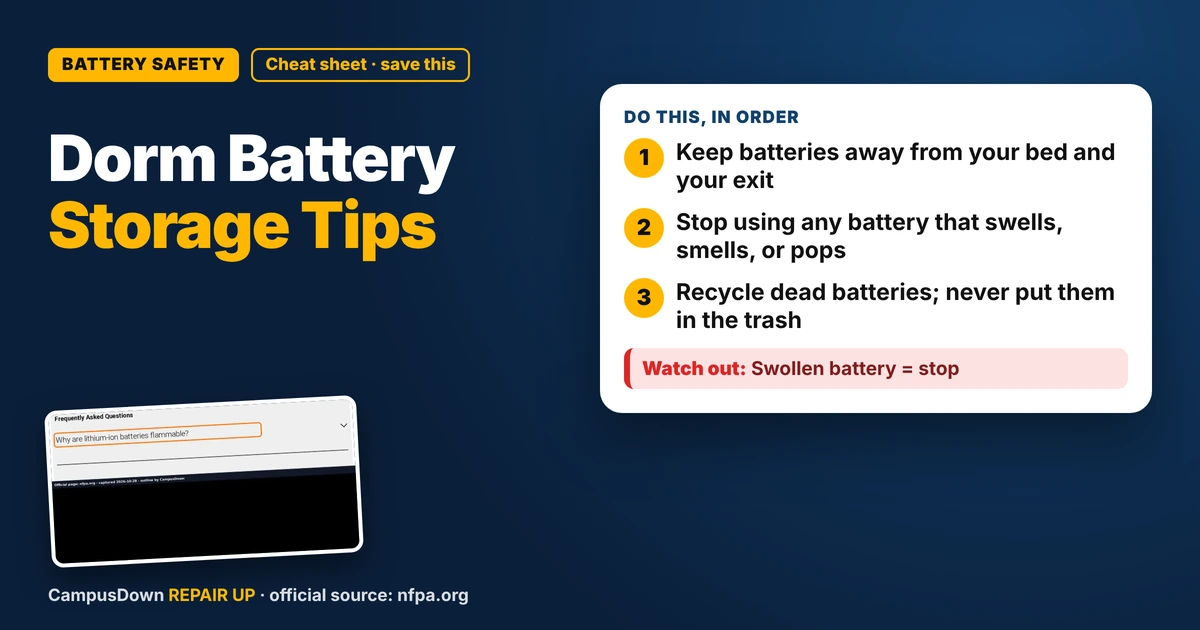
- Keep batteries away from your bed and your exit
- Stop using any battery that swells, smells, or pops
- Recycle dead batteries; never put them in the trash
Count the lithium-ion batteries in your room. Phone, laptop, earbuds, two power banks, a vape your roommate swears isn't his, a cordless vacuum, maybe an e-scooter by the door. My tiny room has more batteries than furniture. So I looked up what NFPA actually says about lithium battery storage in a dorm or small apartment, because "toss it on the bed" isn't a plan.
Why these batteries can be a fire risk
NFPA's lithium-ion battery page explains that these batteries pack a lot of energy into a small space, and if that energy gets released in an uncontrolled way, it creates heat that can turn parts of the battery into flammable and toxic gases.
NFPA lists the usual causes: physical damage (crushed, punctured, or exposed to water), electrical damage (overcharging or using a charger not designed for that battery), extreme temperatures, and product defects.
NFPA's everyday tips
From that same page:
- Buy batteries listed by a nationally recognized testing laboratory and labeled that way.
- Stop charging once the battery is full.
- Use chargers compatible with your device. The safest choice is the one that came with it.
- Stop using a device if the battery shows damage: unusual odor, excessive heat, popping sounds, swelling, or a color change.
- Have repairs done by a qualified professional.
Where to keep them
For e-bikes, e-scooters and similar gear, NFPA says not to store batteries in extremely hot or cold spots or anywhere that blocks the only exit from a room. In a dorm, that "only exit" line is a big deal, since the door is usually the only way out. Parking the scooter right in front of it is the exact thing to avoid.
NFPA's flood guidance also says not to store batteries near evacuation pathways, windows, doors, or sleeping areas. That made me rethink the under-the-pillow habit.
Practical spots in a small room: a desk surface away from the bed, not on a radiator or a sunny windowsill, and not buried under laundry.
Getting rid of old or damaged ones
NFPA says lithium-ion batteries and devices containing them shouldn't go in household trash or recycling bins, since they can start fires in trucks and at facilities. Take them to a separate battery recycling or household hazardous waste drop-off. Many stores that sell lots of batteries run take-back programs, and your local waste or recycling center can usually point you somewhere.
If your campus has a battery drop box, that's the easiest win.
Why we're relaxed about this
Normalcy bias is strong here, since your phone has charged next to your face every night for years. The availability heuristic works both ways: a viral scooter fire video makes you panic for a day, then you forget. And a battery fire releases heat that keeps reacting even with limited oxygen, which is part of why NFPA lists heat, smoke, toxic gases and explosions as the dangers.
Plus procrastination: the puffy old power bank sits in a drawer for a year because the recycling drop-off is "out of the way."
Quick room audit
- Check every battery for swelling or heat.
- Swap random gas-station cables for the original or a compatible charger.
- Unplug once full when you can.
- Keep the doorway clear.
- Bag the dead ones for recycling.
Nothing says "I have my life together" to a date like a tidy charging station instead of a nest of cables on the bed.
Know someone staring at a repair right now? Send this their way.
Pick an app — it just sends the link, nothing else.
Frequently Asked Questions
Where should I store lithium batteries in a dorm?
NFPA says avoid extreme heat or cold and never store them where they block the only exit. Keep them away from exits and sleeping areas.
Can I throw a dead power bank in the trash?
No. NFPA says lithium-ion batteries shouldn't go in household trash or recycling bins; use a battery or hazardous waste drop-off.
What are signs a lithium battery is damaged?
NFPA lists unusual odor, excessive heat, popping sounds, swelling, or a change in color.
Is it okay to use any charger?
NFPA recommends compatible chargers, ideally the one supplied with the device.