My Water Bill Made Me Suspicious of the Toilet
Spot signs your old toilet wastes water: constant running, phantom refills, weak flushes, and a dye test. Plus how to ask your landlord for a fix or upgrade.
“Almost cried fixing my own house. Learned to read every quote instead.”
Theology · Scripture Cards
Open a scripture card
Already read and shared by 315 people.
 Listen to Him
Matthew 17:5
While he was still speaking, behold, a bright cloud overshadowed them. Behold, a voice came out of the cloud, saying, “This is my beloved…
Read this card
 Your God, My God
Ruth 1:16
Ruth said, “Don’t urge me to leave you, and to return from following you, for where you go, I will go; and where you stay, I will stay.…
Read this card
 Water from the Rock
Exodus 17:6
Behold, I will stand before you there on the rock in Horeb. You shall strike the rock, and water will come out of it, that the people may…
Read this card
 Today a Savior Is Born
Luke 2:10-11
The angel said to them, “Don’t be afraid, for behold, I bring you good news of great joy which will be to all the people. For there is born…
Read this card
 I Know That My Redeemer Lives
Job 19:25
But as for me, I know that my Redeemer lives. In the end, he will stand upon the earth.
Read this card
 Be Strong and Courageous
Joshua 1:9
Haven’t I commanded you? Be strong and courageous. Don’t be afraid. Don’t be dismayed, for Yahweh your God is with you wherever you go.”
Read this card
 The Sun of Righteousness
Malachi 4:2
But to you who fear my name shall the sun of righteousness arise with healing in its wings. You will go out and leap like calves of the…
Read this card
 My Heart Rejoices in the Lord
1 Samuel 2:1-2
Hannah prayed, and said, “My heart exults in Yahweh! My horn is exalted in Yahweh. My mouth is enlarged over my enemies, because I rejoice…
Read this card
Key Takeaways
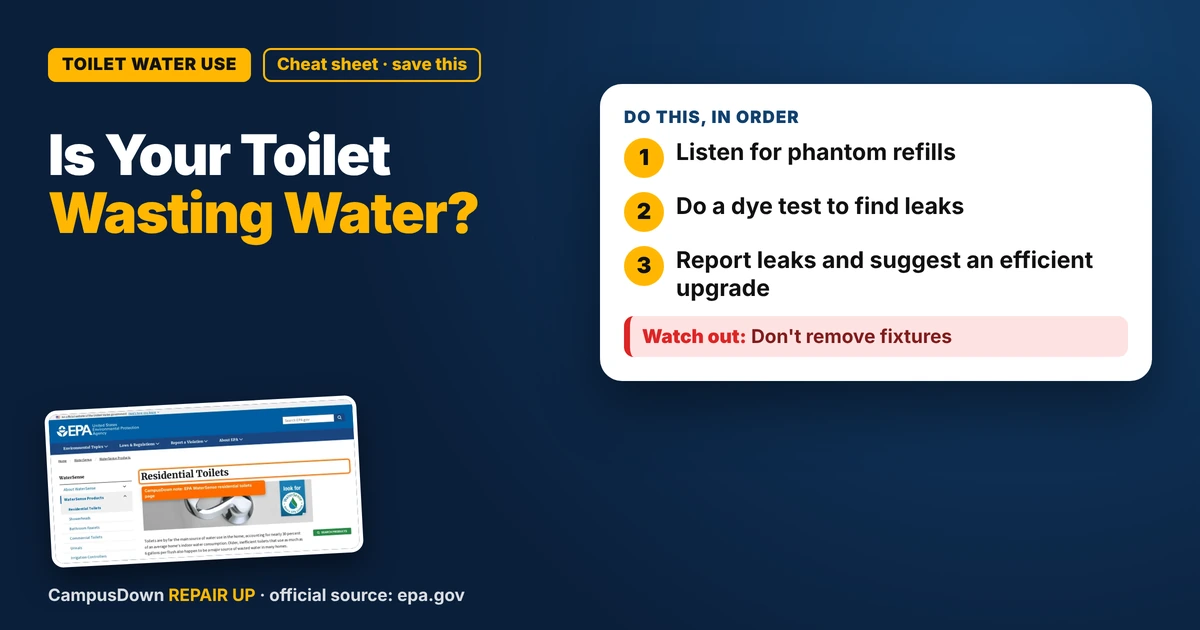
- Listen for phantom refills.
- Do a dye test to find leaks.
- Report leaks and suggest an efficient upgrade.
I split the water bill with a roommate, and when it jumped, we started side-eyeing each other's shower habits. Then I heard the toilet refill on its own in the middle of the night. No one flushed. If you want to know the signs your old toilet wastes water, here's what to look and listen for, plus how to bring it up with your landlord without sounding like a plumber.
Sign 1: Phantom refills
If you hear the tank refilling when nobody used it, water is probably leaking from the tank into the bowl. Often it's a worn flapper.
Sign 2: Constant running
A toilet that keeps running after a flush wastes water fast. Jiggling the handle might stop it temporarily, but it's a sign something's off.
Sign 3: The dye test
- Remove the tank lid carefully.
- Put a few drops of food coloring in the tank.
- Don't flush for a while.
- Check the bowl. If color shows up, there's a leak.
- Flush after the test so the dye doesn't stain.
Sign 4: Weak flushes and double flushing
If you have to flush twice often, you're using double the water. A clog or an old design might be the cause.
What the EPA says
The EPA WaterSense toilets page explains that older toilets can use a lot more water than newer efficient models, and that WaterSense-labeled toilets are certified to use less water while performing well. It's a good page to share with a landlord if you want to suggest an upgrade.
What renters can do
- Report leaks in writing, including what you tested.
- Ask if the flapper can be replaced.
- Mention if the toilet runs constantly or double flushes.
- If your lease lets you, swapping a flapper is a common DIY fix, but ask first.
Why we ignore leaks
A tiny leak is easy to ignore because it's quiet. That's normalcy bias. Each small loss doesn't feel like much, but small losses add up, which is the tragedy of the commons vibe when nobody in a shared house fixes it. And the urge to blame your roommate's showers first is confirmation bias.
Talk to roommates first
Before you text the landlord, loop in your roommates. Share the dye test result so nobody feels blamed. Agree on who sends the message. One clear request is better than three confused ones. And if the bill is shared, decide together how to handle the extra cost while it gets fixed.
Simple water-saving habits
- Don't use the toilet as a trash can.
- Report leaks quickly.
- Check for running toilets before bed.
Found this helpful? Share it with a friend who’s dealing with the same mess.
Pick an app — it just sends the link, nothing else.
Frequently Asked Questions
How do I know if my toilet is leaking?
Listen for phantom refills and do a dye test in the tank.
Do old toilets use more water?
The EPA WaterSense page explains that older toilets can use more water than efficient models.
Can I replace my toilet in a rental?
Not without written permission from your landlord.
What's a WaterSense toilet?
A toilet certified by the EPA WaterSense program to use less water while performing well.