Outlet Warm to the Touch: What It Can Mean and What to Do
Outlet feels warm when you touch it? Unplug, check what's on it, watch for scorch marks and smells, and learn why a warm outlet in a rental should be reported.
“Almost cried fixing my own house. Learned to read every quote instead.”
Theology · Scripture Cards
Open a scripture card
Already read and shared by 315 people.
 Hosanna to the Son of David
Matthew 21:9
The multitudes who went in front of him, and those who followed, kept shouting, “Hosanna to the son of David! Blessed is he who comes in…
Read this card
 I Am with You Always
Matthew 28:20
teaching them to observe all things that I commanded you. Behold, I am with you always, even to the end of the age.” Amen.
Read this card
 God Shut the Lions’ Mouths
Daniel 6:22
My God has sent his angel, and has shut the lions’ mouths, and they have not hurt me, because innocence was found in me before him; and…
Read this card
 Daughter, Your Faith Has Healed You
Mark 5:34
He said to her, “Daughter, your faith has made you well. Go in peace, and be cured of your disease.”
Read this card
 Water from the Rock
Exodus 17:6
Behold, I will stand before you there on the rock in Horeb. You shall strike the rock, and water will come out of it, that the people may…
Read this card
 Your God, My God
Ruth 1:16
Ruth said, “Don’t urge me to leave you, and to return from following you, for where you go, I will go; and where you stay, I will stay.…
Read this card
 This Is My Beloved Son
Matthew 3:16-17
Jesus, when he was baptized, went up directly from the water: and behold, the heavens were opened to him. He saw the Spirit of God…
Read this card
 Twelve Baskets Left Over
John 6:11, 13
Jesus took the loaves, and having given thanks, he distributed to the disciples, and the disciples to those who were sitting down, likewise…
Read this card
Key Takeaways
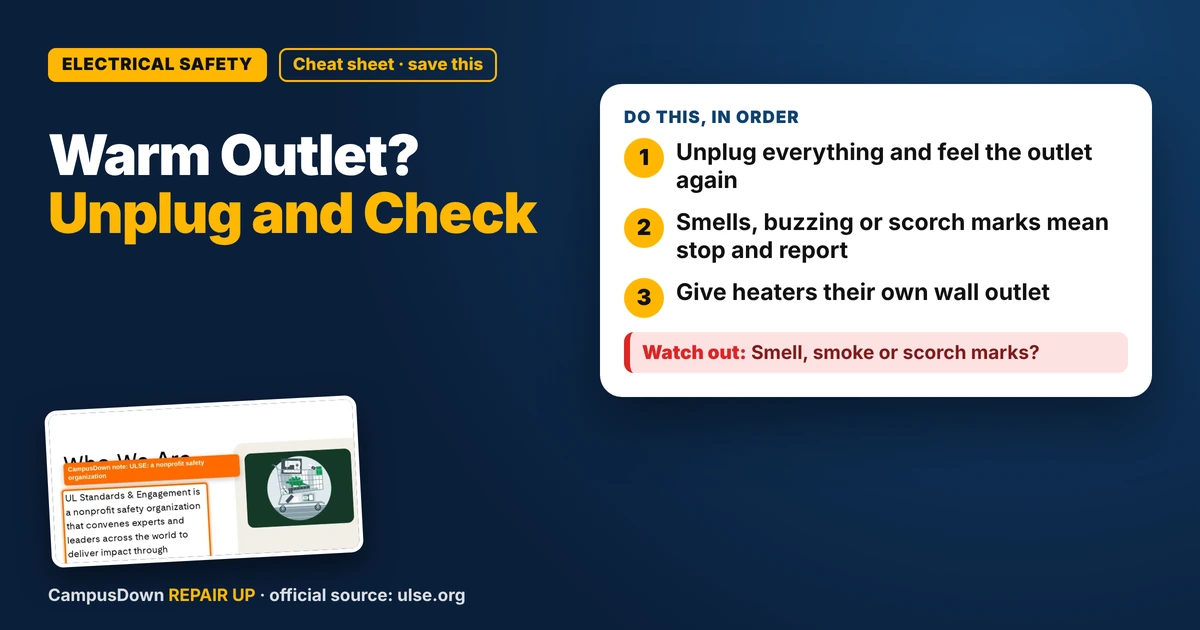
- Unplug everything and feel the outlet again
- Smells, buzzing or scorch marks mean stop and report
- Give heaters their own wall outlet
I was charging my laptop and my phone and running a little heater off one outlet, because apparently I live like a gremlin. When I reached behind the desk, the outlet cover felt warm. Not hot, but definitely warmer than a wall should be. An outlet warm to the touch isn't something to shrug off.
First move
Unplug everything from that outlet. Then wait and feel it again after things cool. If it's still warm with nothing plugged in, or you smell burning plastic, see discoloration or hear buzzing, turn off the breaker for that circuit if you know which one it is, and contact your landlord or an electrician right away.
Why outlets warm up
Electricity flowing through any connection makes some heat. A loose wire, worn outlet contacts or a plug that fits loosely adds resistance. Ohm's law connects voltage, current and resistance, and the takeaway is simple: a bad connection can turn electrical energy into heat right where you don't want it.
High-power devices like space heaters draw a lot of current. Plugging one into a shared outlet with other stuff, or through a cheap adapter, can add up.
Who to trust
UL Standards & Engagement describes itself as a nonprofit safety organization working on standards, education and advocacy, with home safety among its topics. Its homepage doesn't give a checklist for warm outlets, so for the actual diagnosis, a licensed electrician is the right call. I'm not one.
The "it's probably fine" trap
Normalcy bias whispers that nothing bad has happened yet. Optimism bias says fires happen to other people. Those two have talked a lot of people into ignoring warning signs. A warm outlet is cheap to report and expensive to ignore.
In a rental
Outlets are part of the building wiring, which is the landlord's responsibility in most leases. Don't open the cover or swap the outlet yourself. Send a message with:
- Which outlet and room
- What was plugged in
- Whether it's warm with nothing plugged in
- Any smells, sounds or marks
Photos help, especially of discoloration.
Hypothetical
Hypothetical: the outlet only warms when the heater is plugged in, and goes back to normal without it. That still might mean a worn outlet or a heavy load. Mention it to your landlord anyway, since you can't see inside the wall.
Quick habits
Check plugs for a snug fit, retire cords with cracked insulation and don't hide outlets behind piles of stuff where heat can build up.
If this saved you a headache, it might save a friend one too.
Pick an app — it just sends the link, nothing else.
Frequently Asked Questions
Is it normal for an outlet to be warm?
Slight warmth with heavy loads can happen, but a warm outlet with nothing plugged in or with smells or marks needs a pro.
What should I do if an outlet is warm?
Unplug everything, stop using it if there are warning signs and report it.
Can a space heater make an outlet warm?
High-power devices can, especially with loose connections. Plug heaters directly into a wall outlet.
Can I replace the outlet myself in a rental?
Leave building wiring to your landlord or a licensed electrician.