I Rent a Basement Apartment. Should I Worry About Radon?
Should you test for radon in a basement apartment as a renter? Learn what radon is, how home test kits work, and how to share results with your landlord.
“Almost cried fixing my own house. Learned to read every quote instead.”
Theology · Scripture Cards
Open a scripture card
Already read and shared by 315 people.
 He Revealed His Glory
John 2:11
This beginning of his signs Jesus did in Cana of Galilee, and revealed his glory; and his disciples believed in him.
Read this card
 Daughter, Your Faith Has Healed You
Mark 5:34
He said to her, “Daughter, your faith has made you well. Go in peace, and be cured of your disease.”
Read this card
 The Lord, He Is God
1 Kings 18:38-39
Then Yahweh’s fire fell and consumed the burnt offering, the wood, the stones, and the dust; and it licked up the water that was in the…
Read this card
 Enter His Gates with Thanksgiving
Psalm 100:4-5
Enter into his gates with thanksgiving, and into his courts with praise. Give thanks to him, and bless his name. For Yahweh is good. His…
Read this card
 Take Heart, It Is I
Matthew 14:27, 31
But immediately Jesus spoke to them, saying, “Cheer up! It is I! Don’t be afraid.” … Immediately Jesus stretched out his hand, took hold of…
Read this card
 The Lord Will Provide
Genesis 22:14
Abraham called the name of that place “Yahweh Will Provide”. As it is said to this day, “On Yahweh’s mountain, it will be provided.”
Read this card
 Not My Will, but Yours
Luke 22:42
saying, “Father, if you are willing, remove this cup from me. Nevertheless, not my will, but yours, be done.”
Read this card
 For Such a Time as This
Esther 4:14
For if you remain silent now, then relief and deliverance will come to the Jews from another place, but you and your father’s house will…
Read this card
Key Takeaways
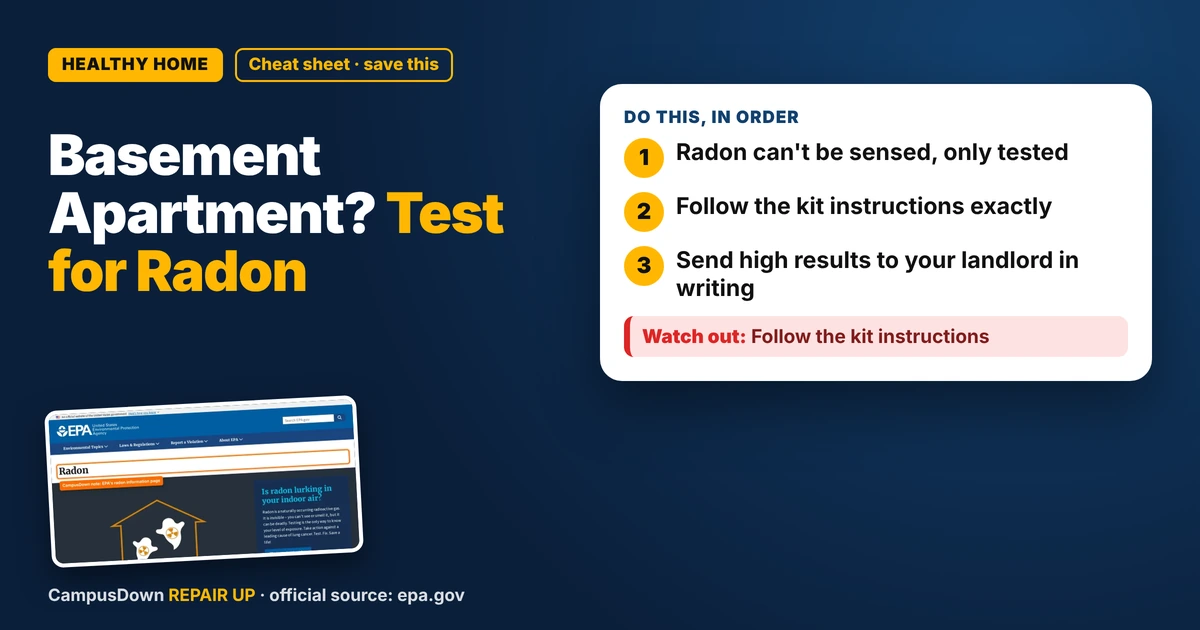
- Radon can't be sensed, only tested.
- Follow the kit instructions exactly.
- Send high results to your landlord in writing.
Basement apartments are the broke student's best friend. Cheap rent, cool in summer, sometimes a little cave-like. But if you've wondered should I test for radon in a basement apartment as a renter, it's a fair question, and the answer from official sources is pretty clear.
What radon is
According to the EPA radon page, radon is a radioactive gas that comes from the natural breakdown of uranium in soil and rock. You can't see it, smell it, or taste it. The EPA calls it the second leading cause of lung cancer in the US and that the only way to know your level is to test.
Radon can enter buildings through cracks and openings where they touch the ground, which is why lower floors get attention. That doesn't mean every basement has a problem. It means you can't know without testing.
How testing works
The EPA says testing is easy and inexpensive. Short-term and long-term test kits are sold for home use. You place the kit where the instructions say, usually on the lowest lived-in level, leave it for the time listed, and mail it to the lab. Read the kit directions carefully, because placement and timing affect the result.
Why we skip it
Invisible risks are easy to ignore. That's normalcy bias: nothing bad has happened, so we assume nothing will. And the ones we hear about less feel less real, thanks to the availability heuristic. A test kit replaces guessing with a number. Putting it off forever is just procrastination with a science label.
Renter steps
Testing your own unit is usually fine since you're just placing a small kit. If results come back high, don't try to fix it yourself. Mitigation is a building job. Share the lab results with your landlord in writing and ask what they plan to do. The EPA site has information on fixing high levels and on finding qualified pros, which you can send along. Some states have their own radon programs too.
Living well down there
While you wait, good general habits help any basement unit: keep air moving, fix leaks fast, and keep things dry. It won't replace a test, but it makes the space nicer.
Found this helpful? Share it with a friend who’s dealing with the same mess.
Pick an app — it just sends the link, nothing else.
Frequently Asked Questions
Should renters test for radon?
The EPA says testing is the only way to know your level, and home kits are easy to use.
Are basement apartments higher in radon?
Radon comes from the ground, so lower levels get attention, but only a test tells you.
What if my radon test is high?
Share the results with your landlord in writing. Mitigation is a building job.
Can I smell radon?
No. The EPA says it has no smell, color, or taste.