Repair and Deduct: What Renters Should Do Before Paying for a Fix
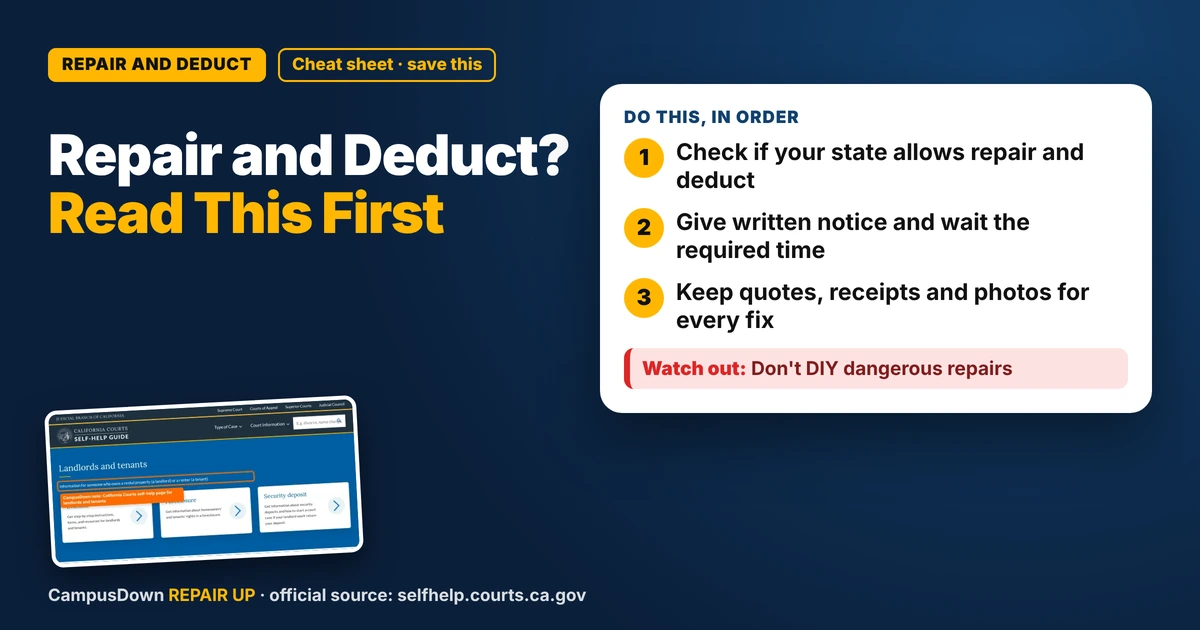
Thinking about repair and deduct? First check if your state allows it, give written notice, wait the required time, keep receipts and read the limits.
“Almost cried fixing my own house. Learned to read every quote instead.”
Theology · Scripture Cards
Open a scripture card
Already read and shared by 315 people.
 Enter His Gates with Thanksgiving
Psalm 100:4-5
Enter into his gates with thanksgiving, and into his courts with praise. Give thanks to him, and bless his name. For Yahweh is good. His…
Read this card
 The Lord, He Is God
1 Kings 18:38-39
Then Yahweh’s fire fell and consumed the burnt offering, the wood, the stones, and the dust; and it licked up the water that was in the…
Read this card
 Daughter, Your Faith Has Healed You
Mark 5:34
He said to her, “Daughter, your faith has made you well. Go in peace, and be cured of your disease.”
Read this card
 Listen to Him
Matthew 17:5
While he was still speaking, behold, a bright cloud overshadowed them. Behold, a voice came out of the cloud, saying, “This is my beloved…
Read this card
 This Is My Beloved Son
Matthew 3:16-17
Jesus, when he was baptized, went up directly from the water: and behold, the heavens were opened to him. He saw the Spirit of God…
Read this card
 Salvation Is of the Lord
Jonah 2:6, 9
I went down to the bottoms of the mountains. The earth barred me in forever; yet you have brought my life up from the pit, Yahweh my God. ……
Read this card
 He Revealed His Glory
John 2:11
This beginning of his signs Jesus did in Cana of Galilee, and revealed his glory; and his disciples believed in him.
Read this card
 Unto Us a Child Is Born
Isaiah 9:6
For a child is born to us. A son is given to us; and the government will be on his shoulders. His name will be called Wonderful Counselor…
Read this card
Key Takeaways
- Check if your state allows repair and deduct.
- Give written notice and wait the required time.
- Keep quotes, receipts and photos for every fix.
Your landlord has ghosted your repair request for weeks, and you've seen a TikTok saying you can just fix it yourself and subtract the cost from rent. That's called repair and deduct, and it's real in some places. But doing it wrong can put you in a worse spot than the broken thing itself. Here's what I'd do first, before spending a cent.
This is general information, not legal advice. Whether repair and deduct is allowed, which repairs qualify, how much you can deduct, how often, and what notice you must give all depend on your state and city. Some places don't allow it at all.
Step 1: Find out if your state allows it
Search your state's official court, housing or attorney general site for "repair and deduct." Courts often run self-help pages for tenants, like California's landlords and tenants self-help page. Write down:
- Whether it's allowed
- What kinds of repairs qualify (often serious habitability problems, not cosmetic stuff)
- Any cap on the amount
- How often you can use it
- The notice and waiting period required
If you can't find a clear answer, contact a local tenant help organization or legal aid before acting.
Step 2: Give proper written notice
Almost every process starts with the landlord knowing about the problem in writing. Send a clear, dated repair request with photos. The photo routine in our documentation guide helps here.
Step 3: Wait the required time
Many rules require giving the landlord a reasonable or specific amount of time to fix it. Don't jump ahead. Track dates in a log.
Step 4: Get quotes and keep receipts
If it's allowed and the time has passed:
- Get written estimates from qualified pros
- Keep receipts and invoices
- Take before and after photos
- Plan for the deduction, using our repair budget calculator to see the hit to your month
Step 5: Tell the landlord what you did
Send a written note explaining the repair, the cost and the deduction, with copies of receipts, following whatever your local rules require.
Why people get stuck
Broken stuff becomes "normal" fast, the status quo bias trap. And landlords usually know the rules better than tenants, a kind of information asymmetry. Learning your local tenant rights and the consumer protection law basics evens that out.
Final thought
Repair and deduct is a tool, not a shortcut. Confirm it's allowed, give written notice, wait, document, then deduct by the book. If in doubt, ask local legal aid first.
Know someone staring at a repair right now? Send this their way.
Pick an app — it just sends the link, nothing else.
Frequently Asked Questions
Is repair and deduct legal everywhere?
No. It depends on your state and city, and some places don't allow it. Check official local resources.
What do I need before using repair and deduct?
Usually written notice to the landlord, a waiting period, and receipts for the repair. Rules vary.
Can I withhold rent instead of repair and deduct?
Rent withholding is a different process with its own rules and risks. Get local legal advice first.
What repairs qualify for repair and deduct?
Often serious habitability issues, not cosmetic ones, but definitions vary by state.