Repair Emergency Fund for Renters: How to Size It Without Guessing
Build a repair emergency fund as a renter by listing what you own, what could break and your deductible. A worksheet with no made-up numbers, just yours.
“Almost cried fixing my own house. Learned to read every quote instead.”
Theology · Scripture Cards
Open a scripture card
Already read and shared by 315 people.
 I Know That My Redeemer Lives
Job 19:25
But as for me, I know that my Redeemer lives. In the end, he will stand upon the earth.
Read this card
 The New Covenant in My Blood
Luke 22:19-20
He took bread, and when he had given thanks, he broke and gave it to them, saying, “This is my body which is given for you. Do this in…
Read this card
 Unto Us a Child Is Born
Isaiah 9:6
For a child is born to us. A son is given to us; and the government will be on his shoulders. His name will be called Wonderful Counselor…
Read this card
 My Heart Rejoices in the Lord
1 Samuel 2:1-2
Hannah prayed, and said, “My heart exults in Yahweh! My horn is exalted in Yahweh. My mouth is enlarged over my enemies, because I rejoice…
Read this card
 The God Who Brought You Out
Exodus 20:2
“I am Yahweh your God, who brought you out of the land of Egypt, out of the house of bondage.
Read this card
 Look and Live
Numbers 21:8-9
Yahweh said to Moses, “Make a venomous snake, and set it on a pole. It shall happen that everyone who is bitten, when he sees it, shall…
Read this card
 God So Loved the World
John 3:16
For God so loved the world, that he gave his only born Son, that whoever believes in him should not perish, but have eternal life.
Read this card
 He Is Not Here, He Has Risen
Matthew 28:5-6
The angel answered the women, “Don’t be afraid, for I know that you seek Jesus, who has been crucified. He is not here, for he has risen…
Read this card
Key Takeaways
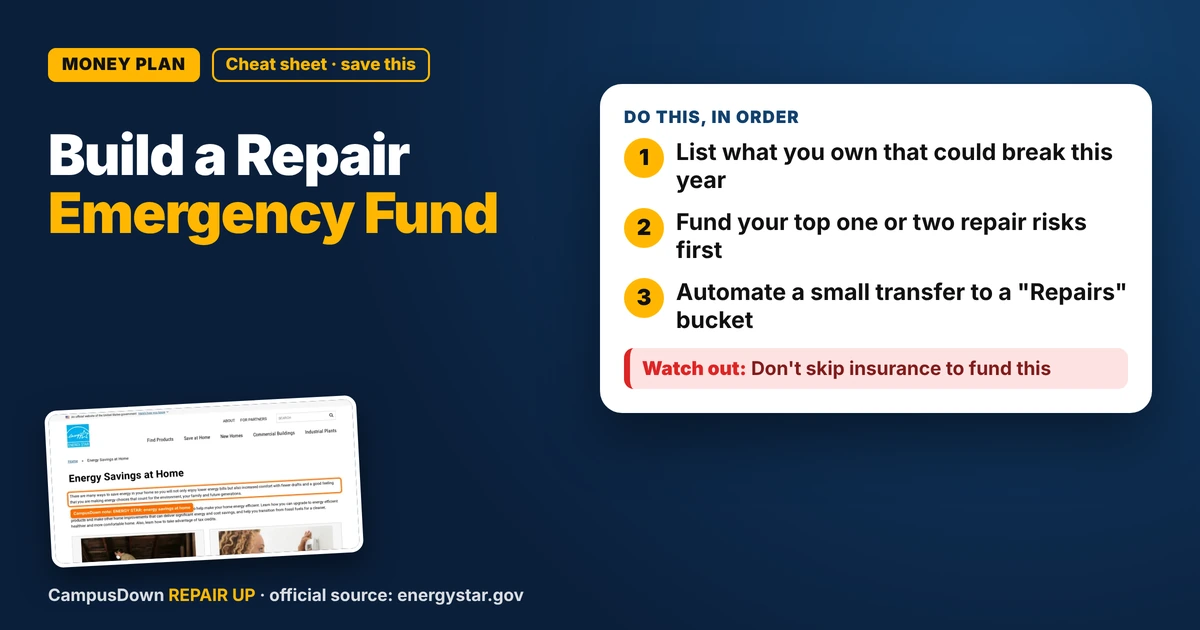
- List what you own that could break this year.
- Fund your top one or two repair risks first.
- Automate a small transfer to a "Repairs" bucket.
Your laptop charger dies. Your bike tire pops. Your landlord fixes the sink but you're on the hook for the renters insurance deductible after a break-in. Life sends small repair bills at the worst times. A repair emergency fund for renters doesn't need to be huge, but it should be based on your stuff, not a random internet number.
What renters usually pay for
Landlords usually handle the building and the appliances that came with it. You usually handle:
- Your own electronics and gadgets
- Your furniture and bike
- Damage you or guests cause
- Your renters insurance deductible, if you have a policy
- Small consumables like bulbs or filters, depending on your lease
Check your lease, because responsibilities vary.
Size it with a worksheet
| Item you own | Likely repair or replace cost (your estimate) | How critical? |
|---|---|---|
| Laptop | ||
| Phone | ||
| Bike | ||
| Mattress or furniture | ||
| Insurance deductible | ||
| Total of top 2–3 critical items |
A common approach is to cover your most likely one or two hits, not everything at once. Run the numbers in our repair budget calculator.
Find the money: cut energy waste
ENERGY STAR's energy savings at home page says there are many ways to save energy at home. For renters, simple habits like setting the thermostat sensibly, sealing drafts with removable products and turning off idle gadgets can free up a bit each month. Send that to the fund.
Make it automatic
- Open a separate savings bucket and name it "Repairs."
- Set a small automatic transfer after each paycheck.
- Refill it after you use it.
The money brain
Labelling money "repairs" makes you less likely to spend it on pizza, that's mental accounting working for you. The first number you read online can anchor your target, so use your own list. And every dollar parked has an opportunity cost, which is why sizing it to your real risks matters.
A starter plan for this month
Pick one number from your worksheet, the cheapest critical item, and make that the first goal. Once you hit it, aim for the next one. Small, specific goals are easier to stick with than "save more money," which nobody has ever finished.
Where to keep the money
Keep it somewhere you can reach in a day or two, but not on the same card you use for food. A separate savings account or a labelled bucket in your banking app works. If your bank lets you nickname accounts, name it something you won't raid, like "Laptop dies" or "Bike tire fund." Silly names are weirdly effective.
Final thought
List what you own, estimate what could break, include your deductible and fund the top one or two hits automatically.
Know someone staring at a repair right now? Send this their way.
Pick an app — it just sends the link, nothing else.
Frequently Asked Questions
How big should a renter's repair emergency fund be?
Size it to your own top one or two likely repair or replacement costs, plus any insurance deductible.
What repairs do renters usually pay for?
Their own belongings, damage they cause and their insurance deductible. Check your lease.
Can saving energy help build the fund?
Yes. Small energy savings can be redirected into the fund each month.
Does an emergency fund replace renters insurance?
No. Insurance covers larger losses, depending on your policy.