Replace Cost vs Repair Cost: How I Decide When to Stop Fixing Something
Replace cost vs repair cost, made simple: compare repair price to replacement, factor in age, energy use, parts and your time, and ignore money already spent.
“Almost cried fixing my own house. Learned to read every quote instead.”
Theology · Scripture Cards
Open a scripture card
Already read and shared by 315 people.
 Take Heart, It Is I
Matthew 14:27, 31
But immediately Jesus spoke to them, saying, “Cheer up! It is I! Don’t be afraid.” … Immediately Jesus stretched out his hand, took hold of…
Read this card
 Hosanna to the Son of David
Matthew 21:9
The multitudes who went in front of him, and those who followed, kept shouting, “Hosanna to the son of David! Blessed is he who comes in…
Read this card
 The Sun of Righteousness
Malachi 4:2
But to you who fear my name shall the sun of righteousness arise with healing in its wings. You will go out and leap like calves of the…
Read this card
 Unto Us a Child Is Born
Isaiah 9:6
For a child is born to us. A son is given to us; and the government will be on his shoulders. His name will be called Wonderful Counselor…
Read this card
 Look and Live
Numbers 21:8-9
Yahweh said to Moses, “Make a venomous snake, and set it on a pole. It shall happen that everyone who is bitten, when he sees it, shall…
Read this card
 Peace, Be Still
Mark 4:39, 41
He awoke and rebuked the wind, and said to the sea, “Peace! Be still!” The wind ceased and there was a great calm. … They were greatly…
Read this card
 I AM WHO I AM
Exodus 3:14
God said to Moses, “I AM WHO I AM,” and he said, “You shall tell the children of Israel this: ‘I AM has sent me to you.’ ”
Read this card
 Meant for Good
Genesis 50:20
As for you, you meant evil against me, but God meant it for good, to save many people alive, as is happening today.
Read this card
Key Takeaways
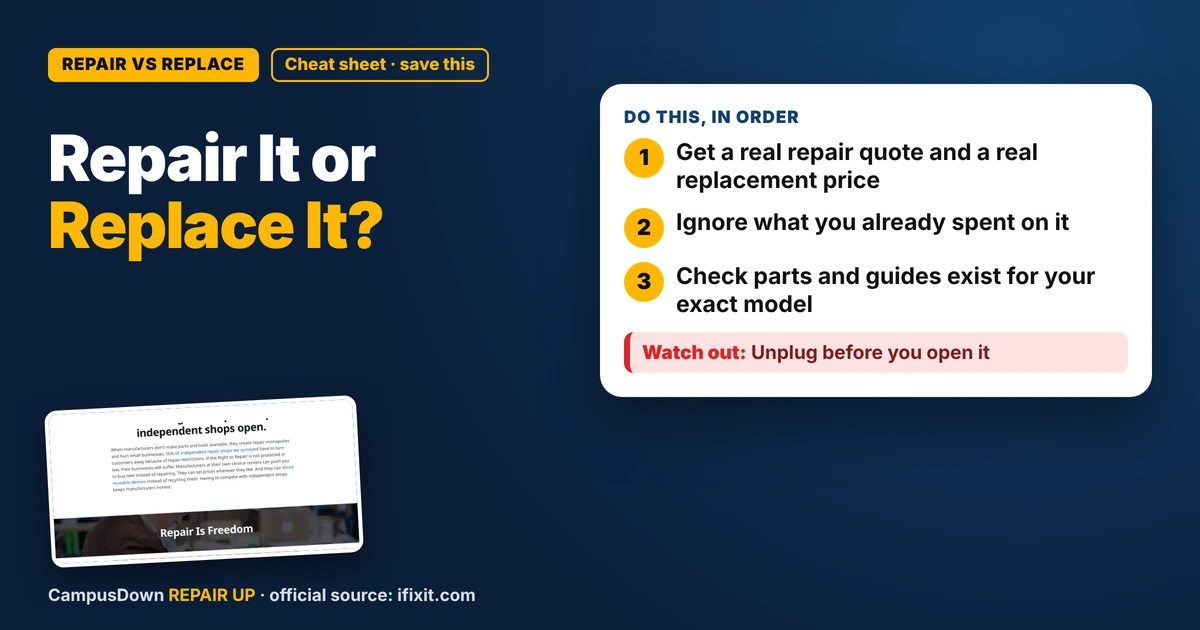
- Get a real repair quote and a real replacement price.
- Ignore what you already spent on it.
- Check parts and guides exist for your exact model.
Every broke student knows this moment. The microwave dies, the laptop fan sounds like a jet, the vacuum smells like burnt toast. You can fix it or replace it, and both options cost money you'd rather spend on literally anything else. Replace cost vs repair cost isn't one magic rule, but there's a clean way to think it through so you don't throw good money after bad, or toss something that just needed a cheap part.
Step 1: Get the two real numbers
You need two prices, and both should be real:
- Repair cost*: a quote from a repair shop, or the price of the part plus tools if you're doing it yourself (with a guide that matches your exact model).
- Replacement cost*: the price of a comparable new or refurbished item today, including delivery and setup.
Find your model number first (usually on a sticker inside the door, on the back, or on the bottom). Without it, you can't get a real part price or the right repair guide.
Step 2: The ratio check
Divide repair cost by replacement cost. Some people use a rule of thumb, like "if repair is more than half the price of new, replace," but that's a personal threshold, not a law. Choose yours based on how old the thing is and how much life it has left.
Repair ratio = repair cost ÷ replacement cost
Lower ratio, lean repair. Higher ratio, lean replace. Then adjust with the next steps.
Step 3: Age and remaining life
An older item is worth less every year, that's depreciation. Fixing something near the end of its life can make sense if the fix is cheap, but a pricey repair on an old item might only buy a little time. Ask the repair shop if other parts are likely to fail soon.
Step 4: Ignore the money you already spent
This is the big one. What you paid for the thing, or for the last repair, is gone either way. Letting it push you toward another repair is the sunk cost fallacy. The only question is: from today, which option costs less for the use you'll get?
There's also the endowment effect: we overvalue stuff just because it's ours. Your old desk chair isn't worth more because it survived finals with you. (Okay, emotionally it is. Financially, nah.)
Step 5: Energy and running cost
For big appliances, the running cost counts. An old fridge or AC that uses a lot of power keeps costing you every month. Compare the yellow EnergyGuide label on a new model with your old model's specs when you can find them, and fold that into the math.
Step 6: Is repair even possible?
Sometimes parts or manuals just aren't available. iFixit's Right to Repair page argues that if you bought it, you own it and should be able to fix it, and it points out that when manufacturers don't make parts and tools available, independent repair gets hard. Before deciding, search for your exact model's guide and parts. If both exist, repair is often realistic. If neither does, that tilts you toward replacing.
Renter note
If the appliance came with the apartment, it's usually the landlord's to repair or replace. Report it in writing and don't pay for a fix yourself without getting the OK first.
Quick decision table
| Situation | Lean |
|---|---|
| Cheap part, guide exists, item otherwise fine | Repair |
| Pricey repair, old item, other parts aging | Replace |
| No parts or guide available | Replace or get a pro opinion |
| Landlord-owned appliance | Report it |
Final thought
Get two real numbers, check the ratio, think about age and running cost, and ignore what you already spent. That's the whole method, and it works for a toaster or a washing machine.
Found this helpful? Share it with a friend who’s dealing with the same mess.
Pick an app — it just sends the link, nothing else.
Frequently Asked Questions
When should I replace instead of repair?
When the repair cost is high compared to replacement, the item is old with other parts aging, or parts and guides aren't available.
Is there a percentage rule for repair vs replace?
Some people use one, like replacing when repair costs more than half of new, but it's a personal rule of thumb, not a standard.
Should I count what I already spent on repairs?
No. Past spending is a sunk cost. Compare only future costs and benefits.
Who fixes appliances in a rental?
Usually the landlord, if the appliance came with the unit. Report the problem in writing.