My Bookshelf Wobbled and I Thought About Earthquakes
How to secure shelves for earthquakes in an apartment or dorm: anchor tall furniture with landlord okay, move heavy stuff low, and plan where you'd take cover.
“Almost cried fixing my own house. Learned to read every quote instead.”
Theology · Scripture Cards
Open a scripture card
Already read and shared by 315 people.
 God So Loved the World
John 3:16
For God so loved the world, that he gave his only born Son, that whoever believes in him should not perish, but have eternal life.
Read this card
 Unto Us a Child Is Born
Isaiah 9:6
For a child is born to us. A son is given to us; and the government will be on his shoulders. His name will be called Wonderful Counselor…
Read this card
 He Revealed His Glory
John 2:11
This beginning of his signs Jesus did in Cana of Galilee, and revealed his glory; and his disciples believed in him.
Read this card
 Hosanna to the Son of David
Matthew 21:9
The multitudes who went in front of him, and those who followed, kept shouting, “Hosanna to the son of David! Blessed is he who comes in…
Read this card
 I AM WHO I AM
Exodus 3:14
God said to Moses, “I AM WHO I AM,” and he said, “You shall tell the children of Israel this: ‘I AM has sent me to you.’ ”
Read this card
 Be Strong and Courageous
Joshua 1:9
Haven’t I commanded you? Be strong and courageous. Don’t be afraid. Don’t be dismayed, for Yahweh your God is with you wherever you go.”
Read this card
 I Will Put Breath in You
Ezekiel 37:5-6
The Lord Yahweh says to these bones: “Behold, I will cause breath to enter into you, and you will live. I will lay sinews on you, and will…
Read this card
 Until He Finds It
Luke 15:4, 6
“Which of you men, if you had one hundred sheep and lost one of them, wouldn’t leave the ninety-nine in the wilderness and go after the one…
Read this card
Key Takeaways
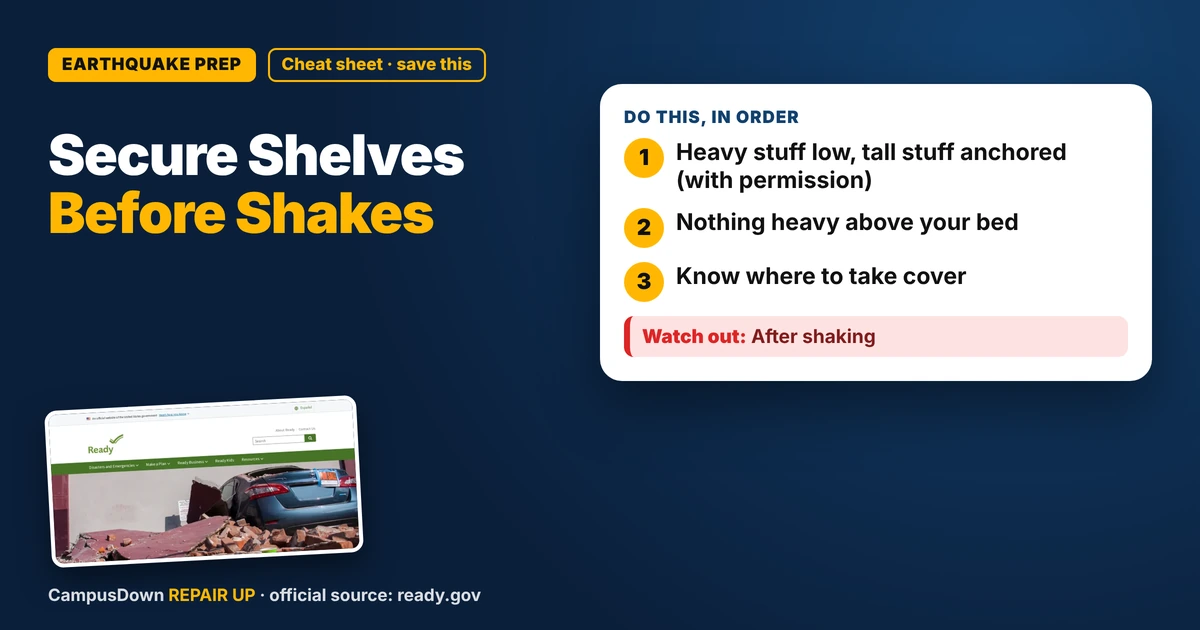
- Heavy stuff low, tall stuff anchored (with permission).
- Nothing heavy above your bed.
- Know where to take cover.
I live in a place where people talk about earthquakes like it's weather. My tall, cheap bookshelf wobbles when I bump it, so I started looking up how to secure shelves for earthquakes in an apartment. Here's what I'd do as a renter without wrecking my deposit.
Step 1: Look at what could fall
- Tall bookshelves and dressers.
- TVs on stands.
- Heavy frames or mirrors above beds or couches.
- Glass items on high shelves.
Think about where you sleep and sit. Anything heavy above or near those spots is the first to fix.
Step 2: Move heavy stuff low
Put heavy books and boxes on the bottom shelves. Light stuff on top. It lowers the center of gravity, so the shelf is less likely to tip.
Step 3: Ask about anchoring
Furniture anchors or straps that connect tall furniture to the wall are commonly recommended for earthquake prep. In a rental, ask your landlord before drilling. Many will agree, especially for safety. Get it in writing.
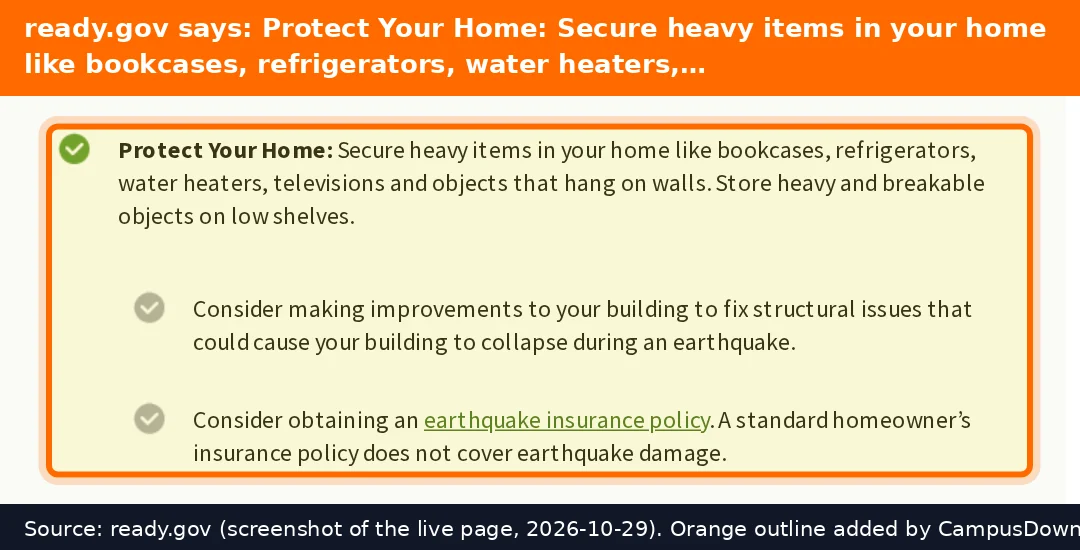
What Ready.gov says
The Ready.gov Earthquakes page covers how to prepare, what to do during shaking, and what to do after. It talks about securing heavy items and practicing Drop, Cover, and Hold On. It's worth bookmarking even if you've never felt one.
Why we skip this
We think "it won't happen this year," which is optimism bias. We also hear stories of quakes with no damage and assume ours will be the same, survivorship bias. And gravity does not care about your deposit when a tall shelf starts to tip.
Build a tiny kit
- Flashlight and extra batteries.
- Water and snacks.
- Shoes by the bed (broken glass is real).
- A phone charger or power bank.
Talk to roommates
Agree on where to take cover and where to meet outside. It's a two-minute conversation that feels awkward but is good adulting.
Found this helpful? Share it with a friend who’s dealing with the same mess.
Pick an app — it just sends the link, nothing else.
Frequently Asked Questions
How do I secure shelves for earthquakes in a rental?
Move heavy stuff low and ask your landlord about anchoring tall furniture to the wall.
What is Drop, Cover, and Hold On?
A common earthquake safety action. See Ready.gov for details.
Can I drill into walls to anchor furniture?
Ask your landlord first and get permission in writing.
What should be in an earthquake kit?
Basics like a flashlight, water, snacks, shoes, and a charger.