Why My Apartment Smoke Detector Kept Chirping (and What Actually Fixed It)
Smoke detector chirping in your apartment? Learn what a single chirp usually means, how to change the battery safely, and when the alarm needs replacing.
“Almost cried fixing my own house. Learned to read every quote instead.”
Theology · Scripture Cards
Open a scripture card
Already read and shared by 315 people.
 The Sun of Righteousness
Malachi 4:2
But to you who fear my name shall the sun of righteousness arise with healing in its wings. You will go out and leap like calves of the…
Read this card
 Meant for Good
Genesis 50:20
As for you, you meant evil against me, but God meant it for good, to save many people alive, as is happening today.
Read this card
 A Fourth Walking in the Fire
Daniel 3:25
He answered, “Look, I see four men loose, walking in the middle of the fire, and they are unharmed. The appearance of the fourth is like a…
Read this card
 Surely I Will Be with You
Judges 6:16
Yahweh said to him, “Surely I will be with you, and you shall strike the Midianites as one man.”
Read this card
 I Am with You
Genesis 28:15
Behold, I am with you, and will keep you, wherever you go, and will bring you again into this land. For I will not leave you until I have…
Read this card
 Look and Live
Numbers 21:8-9
Yahweh said to Moses, “Make a venomous snake, and set it on a pole. It shall happen that everyone who is bitten, when he sees it, shall…
Read this card
 The Rainbow Covenant
Genesis 9:13, 16
I set my rainbow in the cloud, and it will be a sign of a covenant between me and the earth. … The rainbow will be in the cloud. I will…
Read this card
 I Am the Light of the World
John 8:12
Again, therefore, Jesus spoke to them, saying, “I am the light of the world. He who follows me will not walk in the darkness, but will have…
Read this card
Key Takeaways
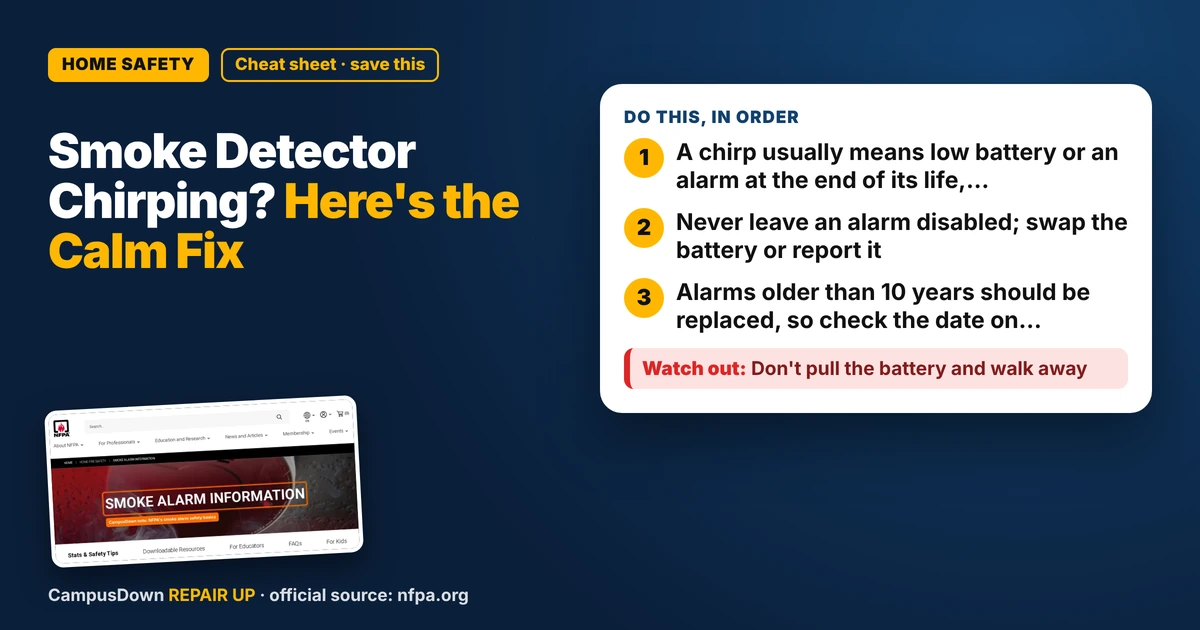
- A chirp usually means low battery or an alarm at the end of its life, not a fire.
- Never leave an alarm disabled; swap the battery or report it.
- Alarms older than 10 years should be replaced, so check the date on the back.
There is no sound on earth more passive-aggressive than one chirp every forty seconds at 3 a.m. You lie there. It chirps. You think you imagined it. It chirps again. If you've got a smoke detector chirping in your apartment, you're not alone, and you're not going crazy.
A chirp is usually the alarm asking for attention, not screaming about a fire. But the fix matters, because a smoke alarm is one of the few things in your place that's literally there to keep you alive.
What a single chirp usually means
A steady, full alarm sound means smoke or a test. A short chirp at regular intervals usually means something else, most often:
- Low battery.* This is the classic cause.
- End of life.* Many alarms chirp when they've reached the end of their service life, even with a fresh battery.
- A loose battery drawer or dust inside.* Sometimes the battery isn't seated right.
- A hardwired alarm with a backup battery.* Plugged-in alarms often have a backup battery that can run low too.
The label on the back of the alarm usually tells you the model and what its chirp patterns mean. Take a phone photo of it before you put the alarm back.
The National Fire Protection Association keeps a plain-English smoke alarm safety page with tips on testing, placement and replacement. It's where I checked how old is "too old" for an alarm.
The safe fix, step by step
- Get a stable step stool.* Not a desk chair with wheels. I say this with love and personal experience.
- Find the right alarm.* Wait for the chirp, then stand under each one. Sound bounces in hallways, so take your time.
- Twist it off its base.* Most turn counterclockwise. Hardwired alarms have a plug on the back; you usually don't need to unplug it to swap the battery, but check the label.
- Swap the battery* with the type printed on the alarm.
- Press and hold the test button* after you put it back. You should hear the full alarm.
- Look for a date* on the back. NFPA recommends replacing smoke alarms once they're 10 years old.
There's a funny brain trap here: the normalcy bias. Because nothing bad has happened before, it's easy to feel like a silent alarm is "fine for now." Fires don't book appointments.
Still chirping after a new battery?
Try these before you give up:
- Reseat the battery and make sure the drawer clicks shut.
- Press and hold the test button for several seconds to clear the alarm's memory (check your model's label).
- Gently vacuum around the vents. Dust can cause false chirps.
- Check the date. If it's old, the alarm itself needs replacing.
Renter version: who replaces the alarm?
In most rentals the landlord provides the smoke alarms and is responsible for working ones, while tenants are often asked to test them and change batteries. Your lease and local rules decide the details. If the alarm is old, damaged, or keeps chirping after you've tried the basics, send a written repair request with a photo of the date label. That's a five-minute message that could matter a lot.
It also helps to think about optimism bias: most of us believe bad stuff happens to other people. A working alarm is how you stop betting on that.
If you're curious about the science, smoke alarms sense combustion particles, which is a nice reminder that heat transfer and smoke move fast in small rooms. Small apartment, small margin. Keep the alarm working.
Know someone staring at a repair right now? Send this their way.
Pick an app — it just sends the link, nothing else.
Frequently Asked Questions
Why is my smoke detector chirping but there's no smoke?
Usually a low battery, an alarm at the end of its service life, a loose battery, or dust. Check the label on the back for your model's chirp meanings.
How do I stop a smoke detector from chirping?
Replace the battery, reseat it, test the alarm, and clean the vents. If it keeps chirping, the alarm may need replacing.
How often should smoke alarms be replaced?
NFPA recommends replacing smoke alarms when they are 10 years old. The manufacture date is usually printed on the back.
Is my landlord responsible for the smoke alarm?
In many places landlords must provide working smoke alarms, while tenants handle testing and batteries. Your lease and local rules decide, so report problems in writing.