Stink Bugs Keep Crawling In Through My Windows
Stink bugs on your windows every fall? University of Maryland Extension says sealing gaps beats spraying. Cheap ways to keep them out and remove them inside.
“Almost cried fixing my own house. Learned to read every quote instead.”
Theology · Scripture Cards
Open a scripture card
Already read and shared by 315 people.
 I Am the Resurrection and the Life
John 11:25-26
Jesus said to her, “I am the resurrection and the life. He who believes in me will still live, even if he dies. Whoever lives and believes…
Read this card
 Let There Be Light
Genesis 1:3-4
God said, “Let there be light,” and there was light. God saw the light, and saw that it was good. God divided the light from the darkness.
Read this card
 Look and Live
Numbers 21:8-9
Yahweh said to Moses, “Make a venomous snake, and set it on a pole. It shall happen that everyone who is bitten, when he sees it, shall…
Read this card
 Surely I Will Be with You
Judges 6:16
Yahweh said to him, “Surely I will be with you, and you shall strike the Midianites as one man.”
Read this card
 Take Heart, It Is I
Matthew 14:27, 31
But immediately Jesus spoke to them, saying, “Cheer up! It is I! Don’t be afraid.” … Immediately Jesus stretched out his hand, took hold of…
Read this card
 Water from the Rock
Exodus 17:6
Behold, I will stand before you there on the rock in Horeb. You shall strike the rock, and water will come out of it, that the people may…
Read this card
 Enter His Gates with Thanksgiving
Psalm 100:4-5
Enter into his gates with thanksgiving, and into his courts with praise. Give thanks to him, and bless his name. For Yahweh is good. His…
Read this card
 Meant for Good
Genesis 50:20
As for you, you meant evil against me, but God meant it for good, to save many people alive, as is happening today.
Read this card
Key Takeaways
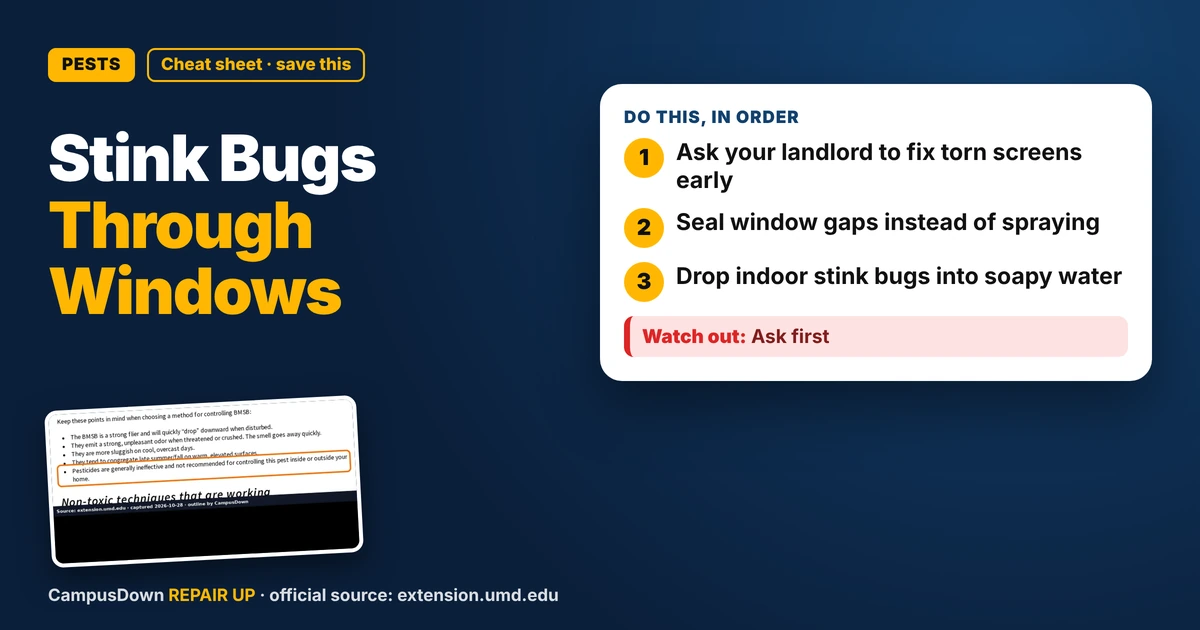
- Ask your landlord to fix torn screens early
- Seal window gaps instead of spraying
- Drop indoor stink bugs into soapy water
Every fall my apartment turns into a stink bug Airbnb. They line up on the window screen like they booked in advance, then one sneaks in and buzzes my lamp while I'm trying to study. If you're dealing with stink bugs coming through windows, here's what the University of Maryland Extension actually recommends, and why squishing them is a rookie move.
Why they show up in fall
UMD Extension's stink bug tips page, about the brown marmorated stink bug, says adults congregate in late summer and early fall and actively seek safe overwintering sites, especially inside buildings. They tend to gather on warm, raised surfaces.
The good news from the same page: they are not harmful to people, houses, or pets. They don't bite, sting, suck blood, or spread disease, and they don't eat or bore into wood. They do emit a strong, unpleasant odor when threatened or crushed, though UMD says the smell goes away quickly.
Sealing beats spraying
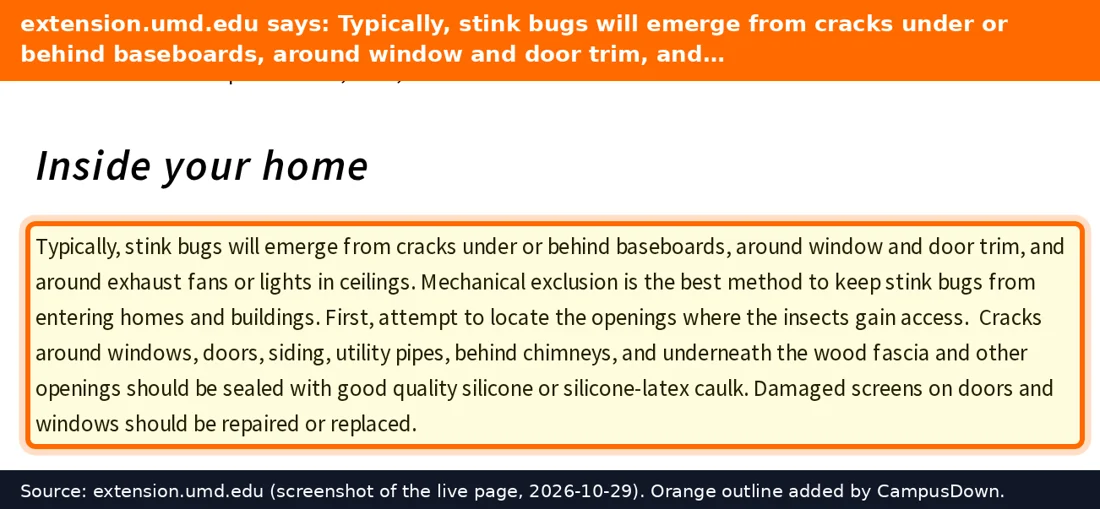
UMD's position is clear: mechanical exclusion is the best method to keep stink bugs out of homes, and pesticides are generally ineffective and not recommended for controlling this pest inside or outside your home.
Exclusion, per UMD, means sealing cracks around windows, doors, siding, utility pipes and other openings with good quality silicone or silicone-latex caulk, and repairing or replacing damaged screens on doors and windows.
For a renter, the realistic move is to email a photo of the torn screen or gappy window frame and ask for a repair. A screen patch kit may be an option if your lease allows small fixes, but check first.
Getting the ones already inside out
UMD lists a couple of low-cost removal options:
- Sweep the bugs into a container of soapy water, or slide the container up a wall, window, or drape so resting bugs drop in.
- Vacuum them up. UMD warns the bag or canister will smell, though the odor is temporary. Some people slip a knee-high stocking over the outside of the vacuum tube with a rubber band, then turn off the vacuum and empty the bugs into soapy water.
UMD also mentions that exterior insecticide applications may offer minor relief where sealing is difficult, and that those should be applied by a licensed pest control operator. That's a landlord-level decision, not a dorm one.
The mental trap
Every year, normalcy bias tells me the screen tear is fine. The availability heuristic makes the one that landed in my hair feel like an invasion. And procrastination keeps the maintenance email in drafts until October. Send it in August, hypothetically, and you might skip the whole season of uninvited roommates.
If this saved you a headache, it might save a friend one too.
Pick an app — it just sends the link, nothing else.
Frequently Asked Questions
Why are stink bugs on my windows?
UMD says adults seek overwintering sites in late summer and fall, often inside buildings, and gather on warm surfaces.
Are stink bugs harmful?
UMD says they don't bite, sting, spread disease, or damage wood; they mostly smell when crushed.
Should I spray stink bugs?
UMD says pesticides are generally ineffective and not recommended; sealing gaps works best.
How do I remove stink bugs inside?
Knock them into soapy water or vacuum them, then empty them into soapy water.