My Apartment Has No Basement, So Where Do I Go?
Finding a tornado safe spot in an apartment with no basement: lowest floor, interior room, away from windows, plus alerts and a tiny kit for students alone.
“Almost cried fixing my own house. Learned to read every quote instead.”
Theology · Scripture Cards
Open a scripture card
Already read and shared by 315 people.
 Your God, My God
Ruth 1:16
Ruth said, “Don’t urge me to leave you, and to return from following you, for where you go, I will go; and where you stay, I will stay.…
Read this card
 The Lord Will Provide
Genesis 22:14
Abraham called the name of that place “Yahweh Will Provide”. As it is said to this day, “On Yahweh’s mountain, it will be provided.”
Read this card
 The Rainbow Covenant
Genesis 9:13, 16
I set my rainbow in the cloud, and it will be a sign of a covenant between me and the earth. … The rainbow will be in the cloud. I will…
Read this card
 Not My Will, but Yours
Luke 22:42
saying, “Father, if you are willing, remove this cup from me. Nevertheless, not my will, but yours, be done.”
Read this card
 Unto Us a Child Is Born
Isaiah 9:6
For a child is born to us. A son is given to us; and the government will be on his shoulders. His name will be called Wonderful Counselor…
Read this card
 I Am with You Always
Matthew 28:20
teaching them to observe all things that I commanded you. Behold, I am with you always, even to the end of the age.” Amen.
Read this card
 My Heart Rejoices in the Lord
1 Samuel 2:1-2
Hannah prayed, and said, “My heart exults in Yahweh! My horn is exalted in Yahweh. My mouth is enlarged over my enemies, because I rejoice…
Read this card
 Until He Finds It
Luke 15:4, 6
“Which of you men, if you had one hundred sheep and lost one of them, wouldn’t leave the ninety-nine in the wilderness and go after the one…
Read this card
Key Takeaways
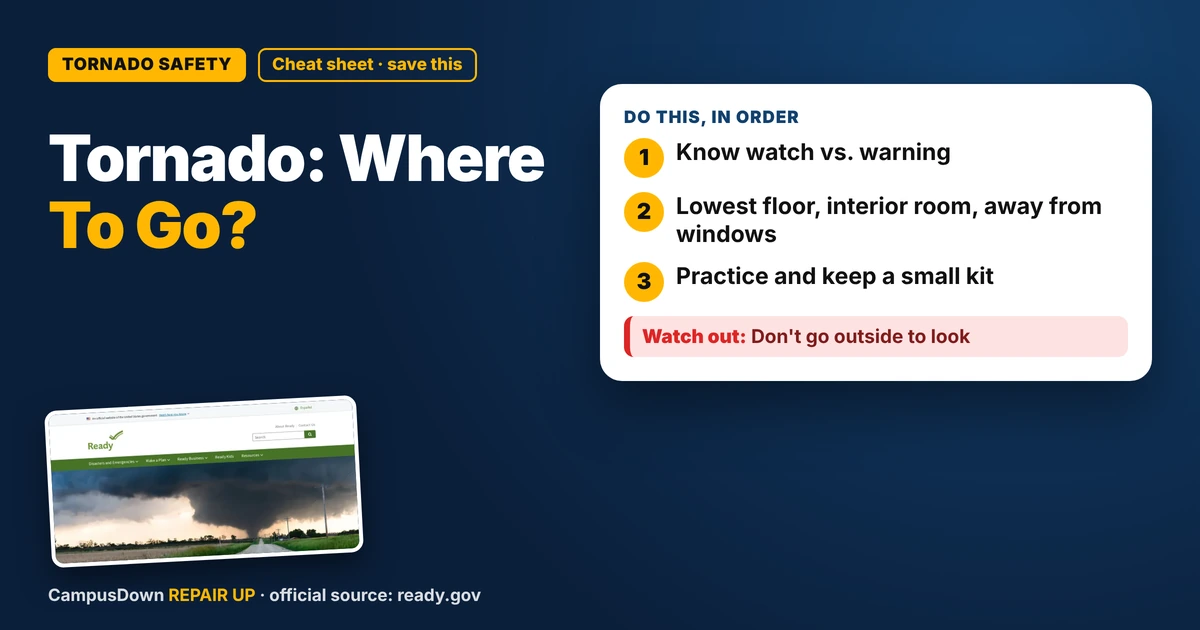
- Know watch vs. warning.
- Lowest floor, interior room, away from windows.
- Practice and keep a small kit.
The tornado sirens went off once, and I stood in the middle of my apartment like a lost puppy. No basement, lots of windows, third floor. If you're figuring out a tornado safe spot in an apartment, here's a simple plan before the next warning.
Step 1: Know the difference
A watch means conditions are possible. A warning means take action now. Sign up for local alerts on your phone so you don't rely only on sirens.
Step 2: Pick your spot
- Go to the lowest floor you can reach safely.
- Choose an interior room or hallway.
- Stay away from windows.
- A small bathroom or closet without windows can be a good option.
If you're on a high floor, ask your landlord or building manager where residents should shelter.
Step 3: Protect yourself
Get down and cover your head and neck. A mattress or heavy blankets can help protect you from debris. Wear shoes.
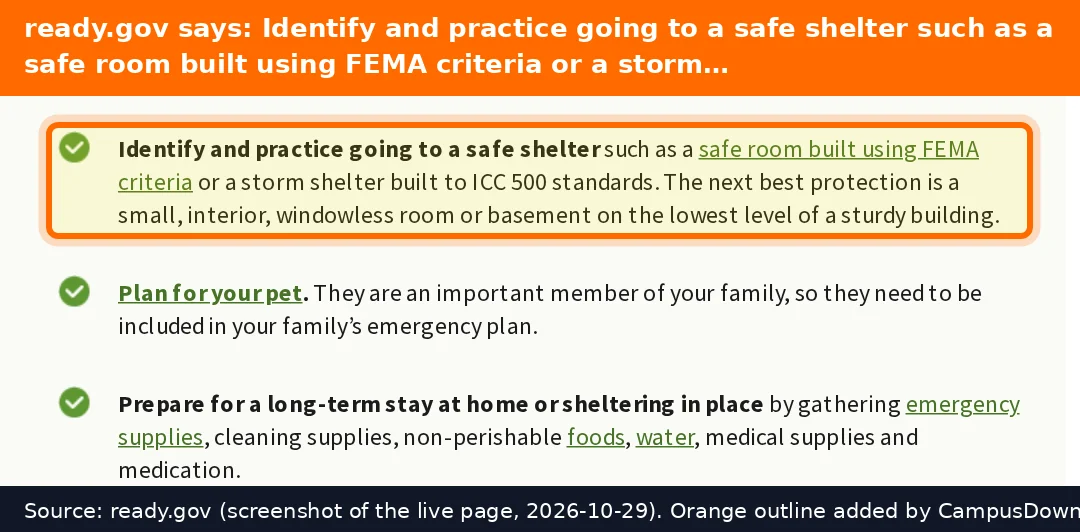
What Ready.gov says
The Ready.gov Tornadoes page explains how to prepare, what to do during a tornado warning, and how to stay safe afterward. It talks about going to a safe room or a small interior room on the lowest level. I trust it more than a random video.
Why we wait
We hear sirens often and think it's another false alarm, which is normalcy bias. We also think "it won't hit here," optimism bias. And checking the news later instead of moving now is plain procrastination.
Tiny kit for your spot
- Flashlight and batteries.
- Shoes and a jacket.
- Phone charger or power bank.
- Water and a snack.
Talk to your building
Ask where the building's safest shelter area is, especially if you're on an upper floor. Share the plan with roommates or neighbors.
Found this helpful? Share it with a friend who’s dealing with the same mess.
Pick an app — it just sends the link, nothing else.
Frequently Asked Questions
Where should I go during a tornado in an apartment?
The lowest floor you can reach, in an interior room or hallway away from windows.
What's the difference between a tornado watch and warning?
A watch means possible; a warning means take action now.
Is a bathroom a good tornado shelter?
A small interior bathroom without windows can be an option.
What should I bring to my tornado safe spot?
Shoes, a flashlight, a charger, water, and something to protect your head.