Hanging Curtains on Drywall Without a Stud
Need to hang a curtain rod or shelf on drywall with no stud? How plastic drywall anchors go in, why the hole size matters, and what renters should ask first.
“Almost cried fixing my own house. Learned to read every quote instead.”
Theology · Scripture Cards
Open a scripture card
Already read and shared by 315 people.
 Daughter, Your Faith Has Healed You
Mark 5:34
He said to her, “Daughter, your faith has made you well. Go in peace, and be cured of your disease.”
Read this card
 Twelve Baskets Left Over
John 6:11, 13
Jesus took the loaves, and having given thanks, he distributed to the disciples, and the disciples to those who were sitting down, likewise…
Read this card
 Until He Finds It
Luke 15:4, 6
“Which of you men, if you had one hundred sheep and lost one of them, wouldn’t leave the ninety-nine in the wilderness and go after the one…
Read this card
 For Such a Time as This
Esther 4:14
For if you remain silent now, then relief and deliverance will come to the Jews from another place, but you and your father’s house will…
Read this card
 Today a Savior Is Born
Luke 2:10-11
The angel said to them, “Don’t be afraid, for behold, I bring you good news of great joy which will be to all the people. For there is born…
Read this card
 God So Loved the World
John 3:16
For God so loved the world, that he gave his only born Son, that whoever believes in him should not perish, but have eternal life.
Read this card
 Take Heart, It Is I
Matthew 14:27, 31
But immediately Jesus spoke to them, saying, “Cheer up! It is I! Don’t be afraid.” … Immediately Jesus stretched out his hand, took hold of…
Read this card
 Surely I Will Be with You
Judges 6:16
Yahweh said to him, “Surely I will be with you, and you shall strike the Midianites as one man.”
Read this card
Key Takeaways
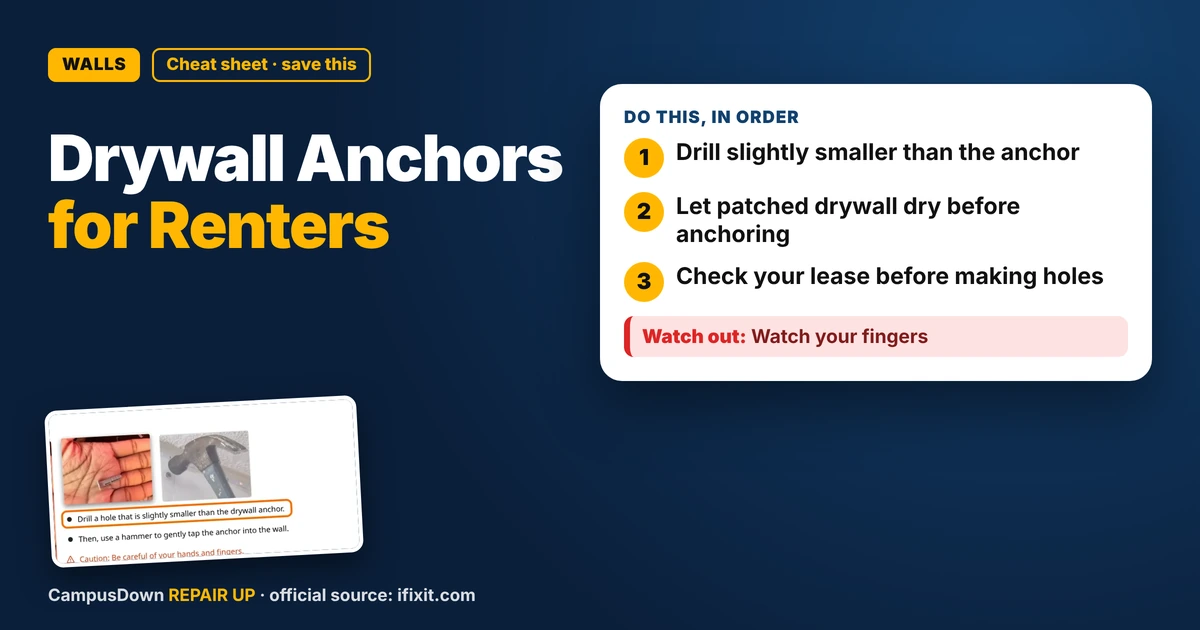
- Drill slightly smaller than the anchor
- Let patched drywall dry before anchoring
- Check your lease before making holes
My first apartment came with blinds that were more like suggestions. Morning sun hit my face at 6 a.m. like an alarm I never set. I wanted real curtains, but the spot I needed had no stud, just plain drywall. Enter the humble plastic anchor. If you're figuring out drywall anchors for renters, here's how they work and what to check before you make holes in a wall you don't own.
Why plain screws fail in drywall
Drywall is basically pressed gypsum with paper on each side. A screw alone has very little to grip, so weight pulls it out. Anchors spread the load into the board. Physics nerds will recognize Newton's laws of motion here: the wall has to push back as hard as the curtain pulls down, and a bare screw just can't.
How a plastic anchor goes in
iFixit has a clear guide on installing a curtain rod on a damaged wall using drywall anchors. The basic sequence:
- Mark where the anchors go, using the rod or a tape measure.
- Drill a hole slightly smaller than the anchor.
- Gently tap the anchor into the wall with a hammer.
- Line up the bracket and drive the curtain rod screws into the anchors.
The "slightly smaller" hole is the key detail: it lets the anchor fit snugly instead of spinning loose.
If the wall is already damaged
That same guide starts by filling damaged drywall holes with compound and letting it dry for up to 3 days before re-anchoring, and notes that spackle needs about 1 day. Don't rush it; anchors in soft, wet patch won't hold.
Measure twice, drill once
The guide marks the anchor spots with a pencil before drilling, and that's the step I'd slow down on. Hold the rod up, check it's level by eye or with a phone level app, then mark. A crooked rod means new holes, and every extra hole is one more thing to patch at move-out. After the rod is up, slide the curtain rings on, set the rod on the brackets, and tug gently to make sure nothing shifts.
The renter checklist
Before drilling anything, I'd check the lease for rules about holes, nails, and anchors, and ask the landlord if unclear. Some places are fine with small holes; others charge for patching at move-out. I'm not quoting any fee because it depends entirely on the lease.
Why we oversimplify
The IKEA effect makes my wobbly install feel great because I did it. The principle of the lever reminds me a long bracket multiplies the pull on the screw. And optimism bias says "it'll hold" right before it doesn't.
Know someone staring at a repair right now? Send this their way.
Pick an app — it just sends the link, nothing else.
Frequently Asked Questions
Why do drywall anchors work better than screws?
They spread the load into the board instead of relying on a screw gripping soft gypsum.
What size hole for a plastic drywall anchor?
iFixit's guide says drill slightly smaller than the anchor, then tap it in.
Can I re-anchor in a damaged wall?
Fill the hole with compound first and let it dry fully before installing anchors.
Can renters use drywall anchors?
Check your lease and ask the landlord; rules about holes vary.