My Washer Flooded the Floor: What to Do Right Now
Washing machine overflowed onto your floor? Calm, cheap first steps for renters: stop the water, get it up fast, dry within 24-48 hours, and tell the landlord.
“Almost cried fixing my own house. Learned to read every quote instead.”
Theology · Scripture Cards
Open a scripture card
Already read and shared by 315 people.
 The Kingdom Belongs to Such as These
Mark 10:14, 16
But when Jesus saw it, he was moved with indignation and said to them, “Allow the little children to come to me! Don’t forbid them, for…
Read this card
 Take Heart, It Is I
Matthew 14:27, 31
But immediately Jesus spoke to them, saying, “Cheer up! It is I! Don’t be afraid.” … Immediately Jesus stretched out his hand, took hold of…
Read this card
 Bread from Heaven
Exodus 16:4
Then Yahweh said to Moses, “Behold, I will rain bread from the sky for you, and the people shall go out and gather a day’s portion every…
Read this card
 Meant for Good
Genesis 50:20
As for you, you meant evil against me, but God meant it for good, to save many people alive, as is happening today.
Read this card
 The God Who Brought You Out
Exodus 20:2
“I am Yahweh your God, who brought you out of the land of Egypt, out of the house of bondage.
Read this card
 Wings like Eagles
Isaiah 40:31
but those who wait for Yahweh will renew their strength. They will mount up with wings like eagles. They will run, and not be weary. They…
Read this card
 This Is My Beloved Son
Matthew 3:16-17
Jesus, when he was baptized, went up directly from the water: and behold, the heavens were opened to him. He saw the Spirit of God…
Read this card
 The Lord Will Provide
Genesis 22:14
Abraham called the name of that place “Yahweh Will Provide”. As it is said to this day, “On Yahweh’s mountain, it will be provided.”
Read this card
Key Takeaways
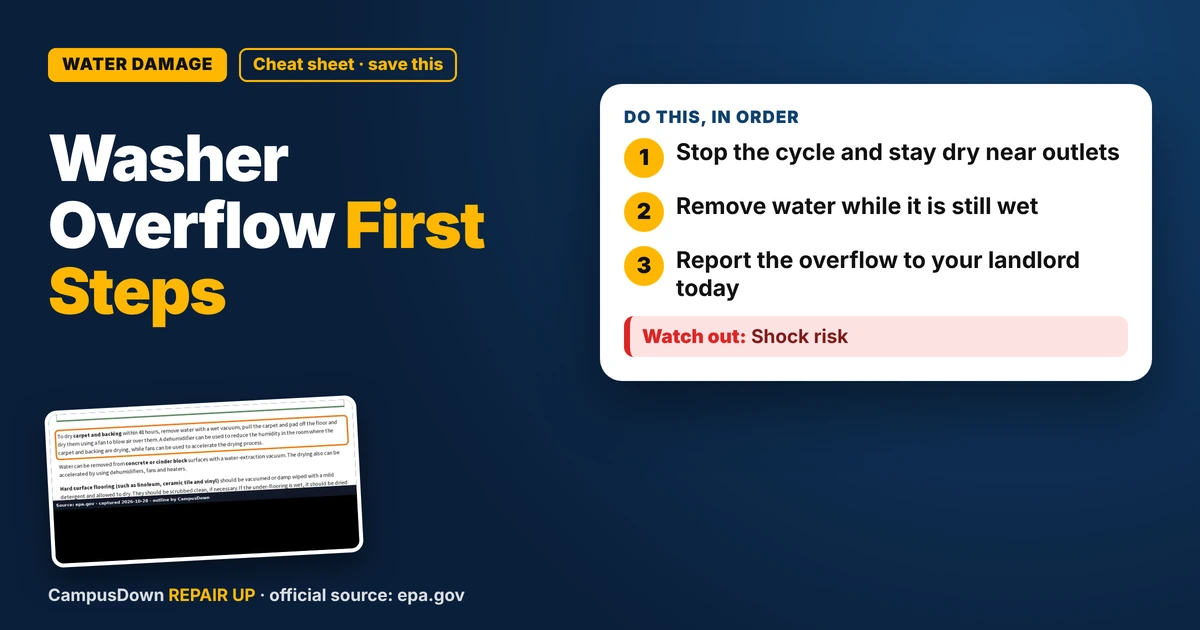
- Stop the cycle and stay dry near outlets
- Remove water while it is still wet
- Report the overflow to your landlord today
There's a special kind of silence when you walk into the laundry corner and your socks squish. Suds everywhere, a puddle creeping toward the rug, and your brain doing the math on a deposit you really need back. If your washer overflowed, the first hour matters more than anything you buy later. Here's what I'd do, using only what EPA actually says.
Step one: stop more water
Don't start mopping while the machine is still running. Stop the cycle and, if you can do it safely, turn the machine off. Only touch controls if you're standing on a dry spot and your hands are dry. If water is near outlets or cords and you're unsure, stay out and call your landlord or building maintenance.
Step two: get the water up fast
EPA's mold course explains that wet, or water-extraction, vacuums are designed to collect water on floors, carpets and hard surfaces, but they should be used only while materials are still wet, and they alone won't dry carpets.
For carpet, EPA describes removing water with a wet vacuum, pulling the carpet and pad off the floor, and drying them with fans blowing air over them, with a dehumidifier to bring down room humidity. As a renter, ask before pulling up carpet; that's the landlord's floor. Towels and a borrowed wet vac are the student version.
The 24-48 hour clock
EPA's brief guide to mold and moisture says that if wet or damp materials are dried 24-48 hours after a leak or spill, in most cases mold will not grow. That's the whole game. Fans running, windows open if the weather allows, wet stuff spread out instead of piled in a corner.
Step three: tell the landlord today
Even if it looks fine, water can soak under flooring or into the wall bottom where you can't see it. Send a short message with the time it happened, what got wet, and photos. Being first to report keeps it a shared problem instead of a mystery stain later.
Why we stall
Cleaning up a flood is gross, so procrastination whispers "I'll deal with it after class." The planning fallacy tells you it'll dry by itself overnight. And the unfinished mess sits in your head all day thanks to the Zeigarnik effect. The fix is boring: do the first hour now, then you can actually stop thinking about it.
Quick checklist
- Stop the cycle; stay dry around electricity.
- Wet vac or towels while things are still wet.
- Fans plus dehumidifier, aiming to dry within 24-48 hours.
- Photos and a message to the landlord the same day.
If this saved you a headache, it might save a friend one too.
Pick an app — it just sends the link, nothing else.
Frequently Asked Questions
How fast do I need to dry a washer overflow?
EPA says if wet materials are dried within 24-48 hours, in most cases mold will not grow.
Will a wet vac dry my carpet?
EPA notes wet vacuums remove water but alone will not dry carpets; fans and a dehumidifier help.
Should I pull up rental carpet myself?
Ask your landlord first, since it is their flooring.
Should I tell my landlord about a small overflow?
Yes, report it the same day with photos, since water can hide under floors.