Water Bill Suddenly High in Your Apartment? Find the Leak First
Water bill suddenly high in your apartment? Use EPA WaterSense's meter test and toilet dye test to find leaks, then report them to your landlord in writing.
“Almost cried fixing my own house. Learned to read every quote instead.”
Theology · Scripture Cards
Open a scripture card
Already read and shared by 315 people.
 His Flesh Was Restored
2 Kings 5:14
Then he went down and dipped himself seven times in the Jordan, according to the saying of the man of God; and his flesh was restored like…
Read this card
 Wings like Eagles
Isaiah 40:31
but those who wait for Yahweh will renew their strength. They will mount up with wings like eagles. They will run, and not be weary. They…
Read this card
 Look and Live
Numbers 21:8-9
Yahweh said to Moses, “Make a venomous snake, and set it on a pole. It shall happen that everyone who is bitten, when he sees it, shall…
Read this card
 Be Strong and Courageous
Joshua 1:9
Haven’t I commanded you? Be strong and courageous. Don’t be afraid. Don’t be dismayed, for Yahweh your God is with you wherever you go.”
Read this card
 I Am the Resurrection and the Life
John 11:25-26
Jesus said to her, “I am the resurrection and the life. He who believes in me will still live, even if he dies. Whoever lives and believes…
Read this card
 I Know That My Redeemer Lives
Job 19:25
But as for me, I know that my Redeemer lives. In the end, he will stand upon the earth.
Read this card
 The Lord, He Is God
1 Kings 18:38-39
Then Yahweh’s fire fell and consumed the burnt offering, the wood, the stones, and the dust; and it licked up the water that was in the…
Read this card
 Let There Be Light
Genesis 1:3-4
God said, “Let there be light,” and there was light. God saw the light, and saw that it was good. God divided the light from the darkness.
Read this card
Key Takeaways
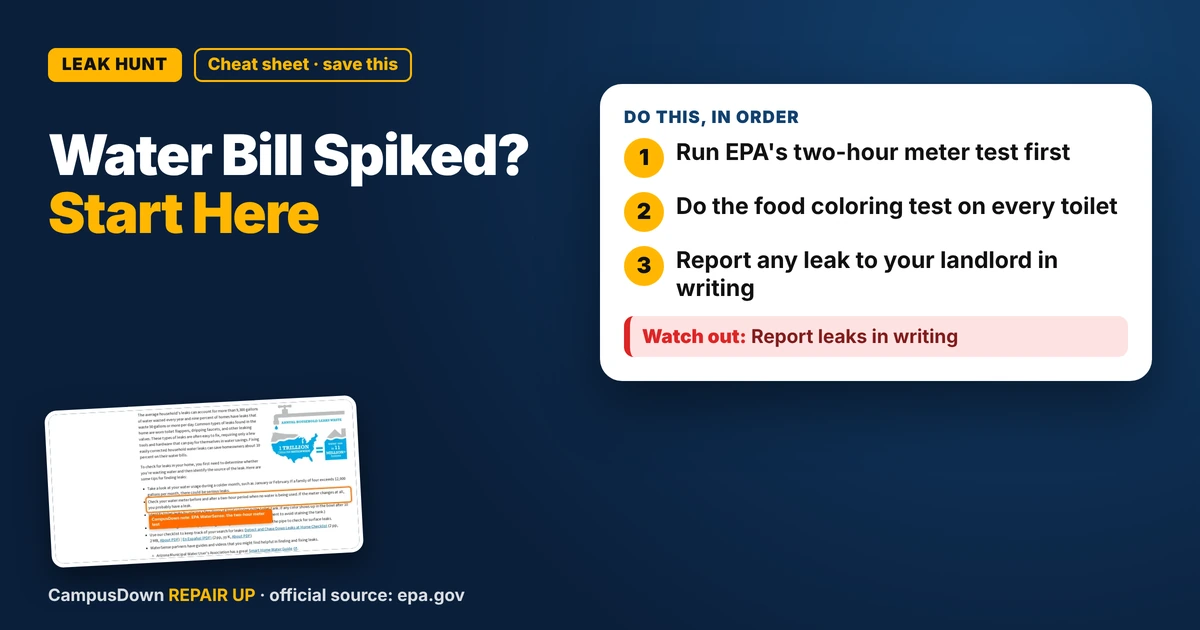
- Run EPA's two-hour meter test first.
- Do the food coloring test on every toilet.
- Report any leak to your landlord in writing.
You open the water bill and do a double take. It's way higher than last month and you didn't suddenly start taking two-hour showers. When the water bill is suddenly high in an apartment, a hidden leak is a common suspect. EPA's WaterSense program has a few easy tests.
If water is billed by the building, ask your landlord how it's split. Some buildings use a formula instead of a meter per unit.
Step 1: The meter test
EPA's Fix a Leak Week page says to check your water meter before and after a two-hour period when no water is being used. If the meter changes at all, you probably have a leak.
If you don't have your own meter, skip to the next steps.
Step 2: The toilet dye test
EPA says to put a few drops of food coloring in the toilet tank. If color shows up in the bowl after 10 minutes, you have a leak. Flush right after so it doesn't stain.
Step 3: Faucets and fittings
EPA says to look at faucet gaskets and pipe fittings for water on the outside of pipes. A faucet dripping once per second can waste more than 3,000 gallons per year, according to EPA.
How much can leaks waste?
From the same EPA page:
- The average household's leaks can account for more than 9,300 gallons of water wasted every year.
- Nine percent of homes have leaks that waste 50 gallons or more per day.
- Fixing easy household leaks can save about 10 percent on water bills.
Leak checklist
| Spot | Test | Found? |
|---|---|---|
| Toilet | Dye test | |
| Kitchen faucet | Look for drips | |
| Bathroom faucet | Look for drips | |
| Showerhead | Drips after shut-off | |
| Under sinks | Wet spots | |
| Meter | Two-hour test |
Why we ignore leaks
A drip doesn't feel urgent, so we put it off, classic procrastination. But once you notice it, it nags at you, the Zeigarnik effect. Use that nag. Pressure inside pipes is real physics too, related to boiling point and pressure concepts, and worn washers can't hold it forever.
What to send your landlord
Keep it short: the date you noticed the higher bill, which test you ran, what you found and a photo or video. Ask when someone can come look. Save a copy in your email. Our documentation guide has tips on photos.
Final thought
Run the meter test, the dye test and a drip check. If you find a leak, report it in writing. If you don't, ask about the billing.
Know someone staring at a repair right now? Send this their way.
Pick an app — it just sends the link, nothing else.
Frequently Asked Questions
Why is my apartment water bill suddenly high?
A hidden leak like a running toilet or dripping faucet is a common cause. Billing errors are another.
How do I test for a leak with my water meter?
EPA says check it before and after two hours with no water use. Any change likely means a leak.
How do I check my toilet for a leak?
Put food coloring in the tank. EPA says color in the bowl after 10 minutes means a leak.
Who fixes leaks in an apartment?
Usually the landlord. Report it in writing with photos.