Who Pays When the Upstairs Neighbor Floods You? How to Sort It Out
Who pays when the upstairs neighbor floods you? Stop the water, alert the landlord, document the source, and figure out which insurance or party handles what.
“Almost cried fixing my own house. Learned to read every quote instead.”
Theology · Scripture Cards
Open a scripture card
Already read and shared by 315 people.
 He Is Not Here, He Has Risen
Matthew 28:5-6
The angel answered the women, “Don’t be afraid, for I know that you seek Jesus, who has been crucified. He is not here, for he has risen…
Read this card
 Today a Savior Is Born
Luke 2:10-11
The angel said to them, “Don’t be afraid, for behold, I bring you good news of great joy which will be to all the people. For there is born…
Read this card
 He Revealed His Glory
John 2:11
This beginning of his signs Jesus did in Cana of Galilee, and revealed his glory; and his disciples believed in him.
Read this card
 For Such a Time as This
Esther 4:14
For if you remain silent now, then relief and deliverance will come to the Jews from another place, but you and your father’s house will…
Read this card
 I Am with You Always
Matthew 28:20
teaching them to observe all things that I commanded you. Behold, I am with you always, even to the end of the age.” Amen.
Read this card
 I Am the Resurrection and the Life
John 11:25-26
Jesus said to her, “I am the resurrection and the life. He who believes in me will still live, even if he dies. Whoever lives and believes…
Read this card
 The Rainbow Covenant
Genesis 9:13, 16
I set my rainbow in the cloud, and it will be a sign of a covenant between me and the earth. … The rainbow will be in the cloud. I will…
Read this card
 Meant for Good
Genesis 50:20
As for you, you meant evil against me, but God meant it for good, to save many people alive, as is happening today.
Read this card
Key Takeaways
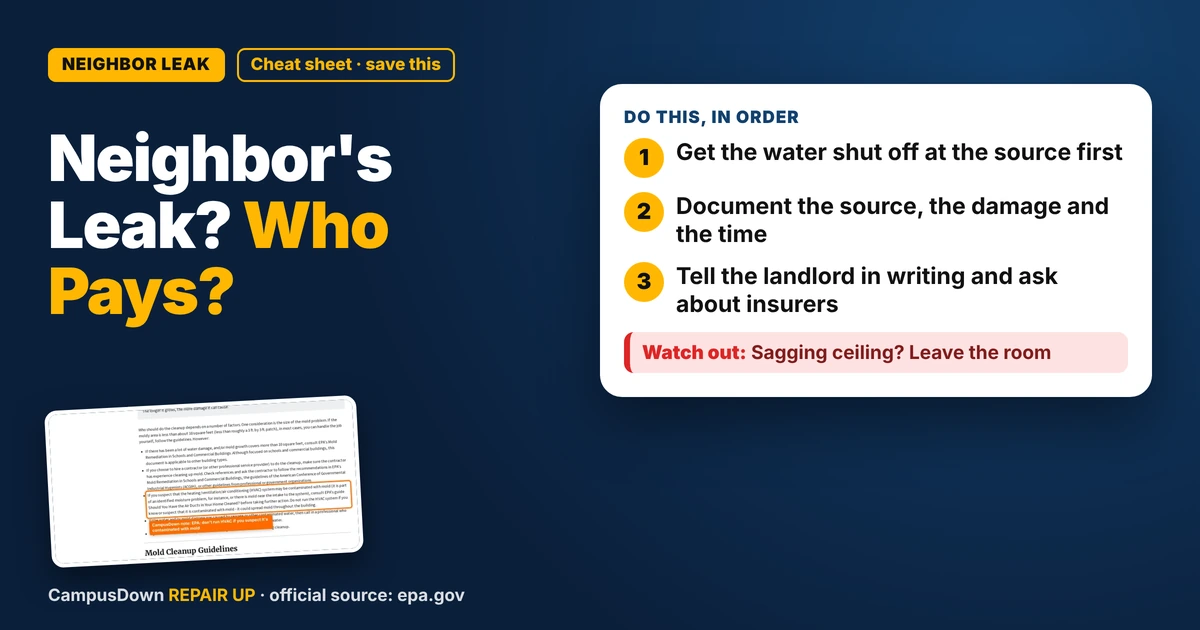
- Get the water shut off at the source first.
- Document the source, the damage and the time.
- Tell the landlord in writing and ask about insurers.
You're watching a YouTube video essay at 1 a.m. when you hear drip, drip, drip. From the ceiling. Above your bed. Your upstairs neighbor's tub, toilet or washer just turned your room into a waterpark. Once the panic settles, the question hits: who pays when the upstairs neighbor floods you? The honest answer is "it depends," but there's a clear process for figuring it out.
This is general information, not legal or insurance advice. Responsibility depends on your lease, the cause, your state's rules and the policies involved.
Right now: water first, blame later
- Knock on their door* or call building maintenance so they shut off the water at the source.
- Stay safe.* If water is near light fixtures, outlets or your power strip, don't touch them. Tell the landlord it's an electrical safety issue.
- Move your stuff* out of the drip zone. Put a bucket or bin under the leak.
- Notify your landlord in writing* immediately, with the time.
Document the source and the damage
- Photos and video of the ceiling, the water, and your damaged items
- A photo of where the water entered if you can see it
- Names of anyone you talked to (neighbor, maintenance)
- Your timeline, in writing, same night if possible
Our guide on how to document water damage has a full photo checklist.
The three usual buckets
How it typically breaks down (verify for your situation):
- The building* (ceiling, walls, floors): generally the landlord's to repair. Their insurance may be involved.
- Your belongings*: often your renters insurance, if you have it, depending on your policy terms.
- The cause*: if the neighbor was careless, their insurance or they personally might be responsible. If a building pipe failed, it's more likely a landlord issue.
Who actually pays depends on the cause and the policies. That's why identifying the source matters so much.
Talk to the right people
- Landlord or property manager*: ask them to inspect, find the cause and repair. Ask which insurer covers the building.
- Your neighbor*: calmly ask if they have renters insurance and if they'd share the insurer's name for a possible claim.
- Your insurer*: call to report it and ask how they handle damage caused by another unit.
Everyone in this situation has some information the others don't, information asymmetry. Get facts in writing to keep it fair.
Watch for mold after
EPA's mold and moisture guide says to dry water-damaged areas within 24 to 48 hours to prevent mold, warns that mold can hide on the back side of drywall and the top side of ceiling tiles, and says not to run the HVAC system if you know or suspect it's contaminated with mold. If the ceiling stays damp or smells musty, tell your landlord in writing again.
About blame and fairness
When insurance pays, people sometimes get less careful, the concept of moral hazard. That's one reason insurers look closely at cause and timing. Your clean records show you acted fast and didn't make it worse. Also, keep the actual risk in perspective: a scary drip isn't always a huge loss, and relative vs absolute risk thinking helps you decide what's worth fighting over.
Final thought
Stop the water, stay safe, document the source, tell the landlord in writing, then sort out the three buckets: building, belongings, cause. That's how "who pays" turns from a fight into a process.
If this saved you a headache, it might save a friend one too.
Pick an app — it just sends the link, nothing else.
Frequently Asked Questions
Who is responsible if my upstairs neighbor floods my apartment?
It depends on the cause, your lease, local rules and insurance policies. The landlord usually handles building repairs, while belongings often fall to your renters insurance or the responsible party.
Should I contact my insurance if a neighbor caused the leak?
Yes, report it and ask how they handle damage caused by another unit.
What should I document after a ceiling leak?
Photos and video of the ceiling and damage, the source if visible, names of people you spoke with and a written timeline.
Is a sagging wet ceiling dangerous?
It can be. Stay out from under it and contact your landlord right away.