Why Does My Faucet Drip? What I Learned From One Very Annoying Sink
Why does my faucet drip? Learn the usual causes, from worn washers to cartridges, the simple checks a renter can do, and when to ask your landlord.
“Almost cried fixing my own house. Learned to read every quote instead.”
Theology · Scripture Cards
Open a scripture card
Already read and shared by 315 people.
 The Lord Will Provide
Genesis 22:14
Abraham called the name of that place “Yahweh Will Provide”. As it is said to this day, “On Yahweh’s mountain, it will be provided.”
Read this card
 Water from the Rock
Exodus 17:6
Behold, I will stand before you there on the rock in Horeb. You shall strike the rock, and water will come out of it, that the people may…
Read this card
 Until He Finds It
Luke 15:4, 6
“Which of you men, if you had one hundred sheep and lost one of them, wouldn’t leave the ninety-nine in the wilderness and go after the one…
Read this card
 Hosanna to the Son of David
Matthew 21:9
The multitudes who went in front of him, and those who followed, kept shouting, “Hosanna to the son of David! Blessed is he who comes in…
Read this card
 Peace, Be Still
Mark 4:39, 41
He awoke and rebuked the wind, and said to the sea, “Peace! Be still!” The wind ceased and there was a great calm. … They were greatly…
Read this card
 I Know That My Redeemer Lives
Job 19:25
But as for me, I know that my Redeemer lives. In the end, he will stand upon the earth.
Read this card
 The Lord Is My Shepherd
Psalm 23:1, 4
Yahweh is my shepherd; I shall lack nothing. … Even though I walk through the valley of the shadow of death, I will fear no evil, for you…
Read this card
 For Such a Time as This
Esther 4:14
For if you remain silent now, then relief and deliverance will come to the Jews from another place, but you and your father’s house will…
Read this card
Key Takeaways
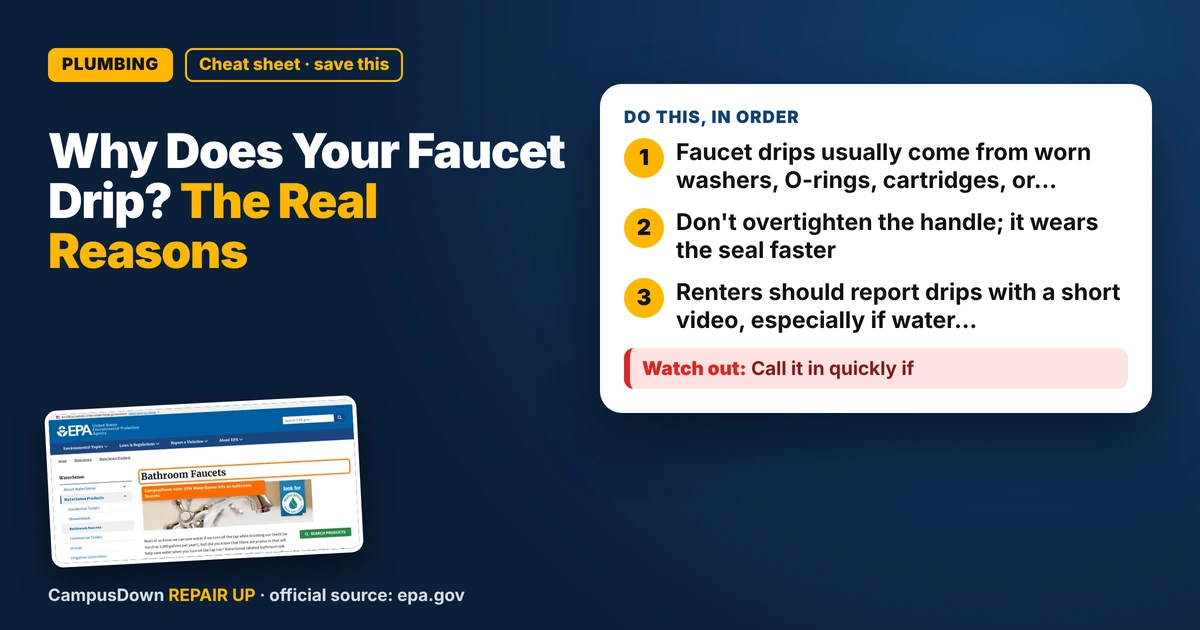
- Faucet drips usually come from worn washers, O-rings, cartridges, or mineral buildup.
- Don't overtighten the handle; it wears the seal faster.
- Renters should report drips with a short video, especially if water pools under the sink.
Plink. ... Plink. ... Plink. My bathroom faucet had a rhythm, and it was not a good one. I tried cranking the handle tighter, which helped for exactly one hour. If you've been asking yourself why does my faucet drip even when it's "off," here's what's usually going on inside, and what you can fix without losing your deposit.
What's actually happening inside the faucet
When you turn a faucet off, a part inside presses against the water flow to seal it. Depending on the faucet, that part might be a rubber washer, an O-ring, a cartridge, or ceramic discs. Over time they wear down, mineral deposits build up, or a seal gets nicked. Water slips past, and you get a drip.
Here are the usual suspects:
- Worn washer or O-ring* (common in older two-handle faucets)
- Worn cartridge* (common in single-handle faucets)
- Mineral buildup* on the seat where the seal sits
- Loose parts* inside the handle
If it drips from the spout, it's usually the seal. If water leaks around the handle, it's often an O-ring or loose part.
The EPA's WaterSense program has a bathroom faucets page about saving water at the sink, and its Fix a Leak campaign notes that a faucet dripping once per second can waste more than 3,000 gallons a year. That's a lot of water for one tiny plink.
Tiny repeated losses add up the way compound interest does in reverse. One drip feels like nothing; a year of drips is a lot of water.
Checks you can do in ten minutes
- Turn the handle off gently but fully.* Overtightening wears the seal faster, so don't crank it.
- Check whether it's hot, cold, or both.* Feel the drip after a few minutes. That tells you which side's parts are worn.
- Look for the shutoff valves under the sink.* Know where they are before you try anything.
- Clean the aerator* at the tip of the spout. It doesn't stop drips, but it's often clogged and easy to unscrew and rinse.
- Look at the handle.* If it wobbles, a small set screw under a decorative cap may just need tightening.
Should a renter replace the cartridge?
Replacing a washer or cartridge is a classic DIY job for homeowners, and iFixit and the manufacturer often have guides. But as a renter, I'd ask first. Faucets are usually the landlord's to maintain, the right replacement part depends on the brand and model, and a mismatched part can turn a drip into a leak.
The pull to do it myself is the IKEA effect: we value things more when we put in the work. Great for bookshelves, risky for someone else's plumbing.
Write a short request: which faucet, where it drips (spout or handle), hot or cold, and since when. Add a 10-second video. That one message saves a back-and-forth.
Don't let it slide
Drips are easy to ignore because they're quiet in the daytime. That's procrastination on easy mode. Put in the request now, while you're thinking about it.
Know someone staring at a repair right now? Send this their way.
Pick an app — it just sends the link, nothing else.
Frequently Asked Questions
Why does my faucet drip when it's turned off?
Usually a worn washer, O-ring, or cartridge, or mineral buildup where the seal sits. The water slips past the worn part.
Is a dripping faucet a big deal?
It can waste a surprising amount of water. EPA's Fix a Leak campaign notes one drip per second can add up to more than 3,000 gallons a year.
Can I fix a dripping faucet myself as a renter?
Simple checks like tightening a loose handle or cleaning the aerator are usually fine. For replacing parts, check your lease and ask your landlord first.
How do I tell which part of the faucet is leaking?
A drip from the spout usually means a worn seal or cartridge. Water around the handle often points to an O-ring or loose parts.